When a Personal Nutritionist Makes More Sense Than an App


Nutrition apps can be useful. They remind you to log breakfast, estimate calories, scan barcodes, and turn abstract food choices into numbers. For many people, that is enough to build awareness.
But there is a point where an app starts to feel like a very organized guess. You log meals, hit a protein target, maybe close a few rings, yet your energy, body composition, labs, digestion, performance, or long-term consistency still do not improve the way you expected.
That is when a personal nutritionist, ideally a registered dietitian or credentialed nutrition professional, can make more sense than another subscription.
The difference is not just human encouragement. A good nutrition coach interprets context. They can connect your schedule, training load, biomarkers, sleep, stress, food preferences, medications, travel, family demands, and actual behavior into a plan you can follow. Apps can track inputs. A skilled professional helps decide what those inputs should mean.
Apps are helpful, but they are not the whole strategy
Food tracking apps solve one major problem: most people underestimate what, when, and how much they eat. Self-monitoring is consistently associated with better weight-management outcomes, and a systematic review on self-monitoring in weight loss found that more consistent tracking tends to be linked with greater success.
That does not mean tracking is the same thing as coaching.
An app can tell you that your lunch had 38 grams of protein. It usually cannot tell you whether that lunch fits your recovery needs after heavy lower-body training, whether your afternoon cravings are related to under-fueling earlier in the day, or whether your “healthy” low-carb approach is hurting performance because your workouts require more glycogen.
Apps are best when your goal is simple and your life is predictable. They can work well if you want to increase protein, learn portion sizes, reduce mindless snacking, or create a short-term calorie deficit. But the more variables involved, the more likely you are to need interpretation rather than automation.
When a personal nutritionist makes more sense
A personal nutritionist becomes the better choice when the consequences of guessing are higher, when your goals are more specific, or when you have already tried apps and stalled.
This is especially true for busy professionals in San Francisco who eat client dinners, commute between meetings, train early or late, and want measurable improvements without turning food into a second job. It is also true for people pursuing longevity, athletic performance, improved metabolic health, or body composition changes that need more precision than generic macro targets.
Here are the clearest signs that an app is not enough.
You need a plan that adapts to your real life
Most apps assume consistency. Your life probably does not.
A week might include a red-eye flight, two restaurant dinners, a board meeting breakfast, a hard workout, a missed lunch, and a weekend family event. An app may record the chaos, but it does not necessarily help you navigate it.
A personal nutritionist can build flexible rules for the life you actually live. That might mean deciding what to eat before a late work dinner, how to structure protein when you skip breakfast, how to order at restaurants without overthinking, or how to adjust carbs on training and non-training days.
Professional support can help when general nutrition advice does not address your circumstances. Look for someone with appropriate qualifications who can explain the reasoning behind their guidance.
Your goals are tied to biomarkers, not just weight
If your only metric is the number on the scale, an app may be enough for a while. But many people care about more than weight. They want better cholesterol, improved glucose control, lower inflammation, healthier body composition, better energy, or a stronger long-term health trajectory.
That requires a more nuanced conversation.
For example, two people can eat the same number of calories and have very different needs. One may need more fiber and unsaturated fats to support LDL cholesterol. Another may need carbohydrate timing to stabilize training energy. A third may need to increase calories because chronic under-eating is limiting strength gains and recovery.
Research supports the importance of individualized lifestyle intervention. In the landmark Diabetes Prevention Program, an intensive lifestyle intervention reduced the incidence of type 2 diabetes by 58% compared with placebo among high-risk adults, as reported in the New England Journal of Medicine. The intervention was not just a tracking tool. It involved structured behavioral guidance, goals, support, and follow-up.
At Custom Fit, nutrition coaching can be paired with objective testing, which makes the conversation more specific. If you are using labs to guide your strategy, the article on working with a registered dietitian in San Francisco when bloodwork is involved explains why biomarkers can change nutrition recommendations in practical ways.
You have hit a plateau despite “doing everything right”
Plateaus are where apps often become frustrating. You log more carefully, eat the same foods, and feel as though discipline should be enough. But plateaus can happen for many reasons.
Your calorie intake may have drifted upward, but it is also possible your energy expenditure changed, your training no longer creates enough stimulus, your protein distribution is poor, sleep is disrupting hunger regulation, or your weekends are offsetting weekday consistency. It may also be that the goal itself needs refinement.
A personal nutritionist can look beyond the dashboard and ask better questions:
- Are you actually recovering from your workouts?
- Are restaurant meals creating more variability than you realize?
- Are you choosing a diet style that fits your preferences long term?
- Are you losing muscle while trying to lose fat?
- Are cravings a willpower issue, or a fueling issue?
That last point matters. A randomized clinical trial comparing healthy low-fat and healthy low-carbohydrate diets found no significant difference in weight loss between the two approaches at 12 months, as shown in the DIETFITS study published in JAMA. For many people, the “best” diet is not the trendiest one. It is the approach they can execute consistently while supporting health markers and training.
You care about body composition, not just weight loss
Weight loss and fat loss are not the same thing. If you are strength training, returning to fitness, or trying to age well, preserving or gaining lean mass matters.
This is a major reason an app can fall short. It may reward a lower calorie number without understanding whether that deficit is too aggressive for your training, whether protein is distributed well across meals, or whether your plan supports recovery.
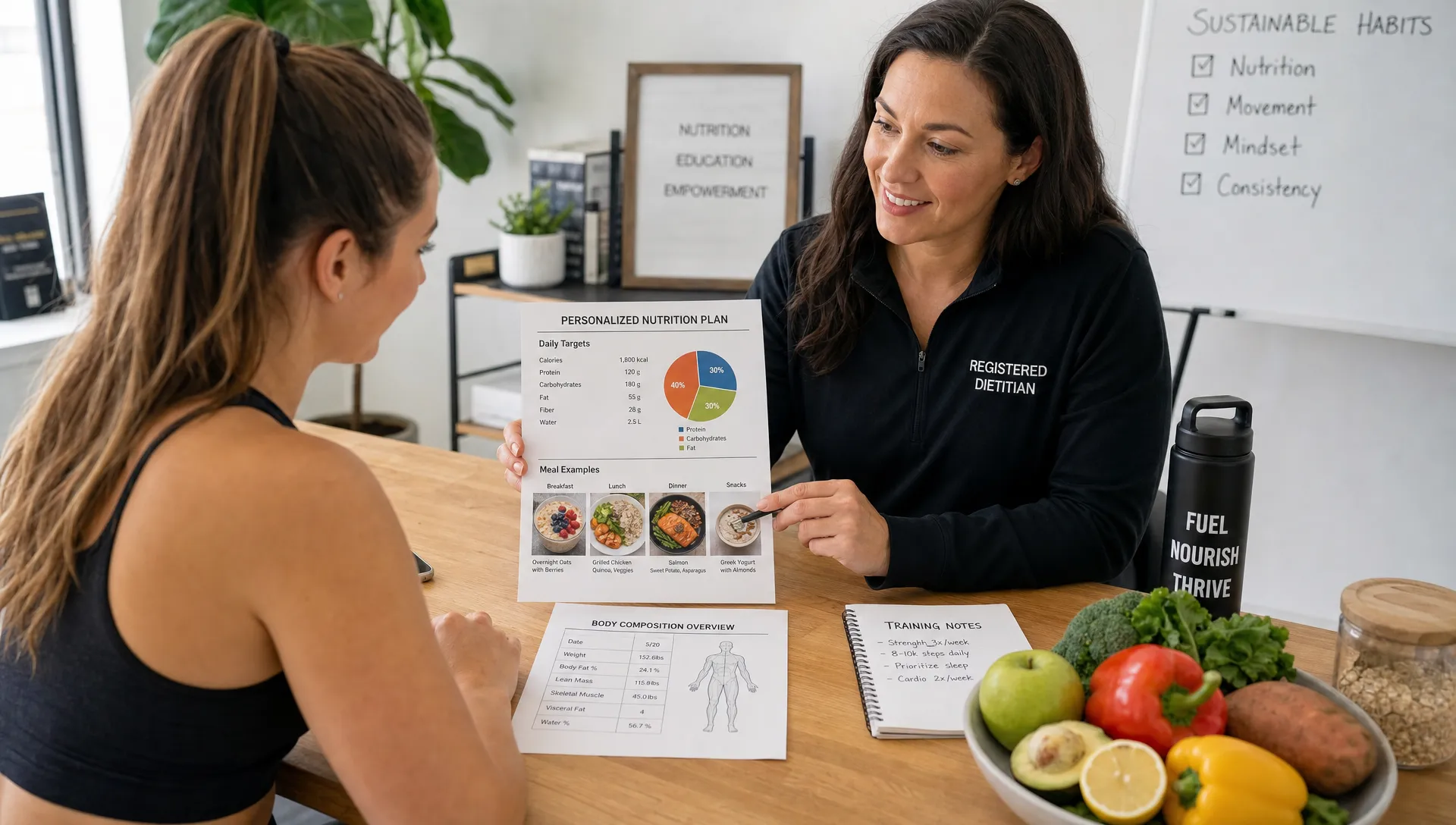
Body composition data can make nutrition more precise. A DEXA scan, for example, can help distinguish fat mass from lean mass and provide a clearer baseline than scale weight alone. When that data is paired with coaching, the goal becomes more intelligent than “eat less.” It becomes “fuel in a way that supports the outcome you actually want.”
Custom Fit’s approach to combining DEXA-informed personal training with nutrition coaching is built around this idea: better data can lead to better decisions when someone qualified helps interpret it.
You are training hard and your nutrition is limiting performance
People often think of a personal nutritionist only when they want to lose weight. In reality, nutrition coaching may be even more valuable when performance is the goal.
If you lift, run, cycle, play recreational sports, or train for longevity, food is not just about calories. It affects recovery, strength, power, hydration, sleep quality, and readiness for the next session.
Common performance nutrition mistakes include eating too little before training, cutting carbs too aggressively, underestimating protein needs, failing to hydrate, or treating rest days and intense training days exactly the same. Apps can show the numbers, but they may not know how to periodize food around your workouts.
For gym-goers, even small nutrition changes can have outsized effects. If you want practical basics before moving into deeper personalization, Custom Fit’s guide to nutrition for gym-goers covers simple principles like protein, carbohydrates, hydration, and calorie alignment.
You want less food noise, not more of it
One overlooked problem with apps is that they can make some people think about food more than necessary. For a short period, logging can build awareness. Over time, however, constant tracking may become draining or counterproductive.
A personal nutritionist can help you move from tracking to skills. Instead of logging forever, you can learn repeatable meal structures, hunger and fullness cues, restaurant strategies, grocery defaults, and travel routines. The goal is not dependency. The goal is competence.
This matters for long-term adherence. Research comparing popular diet approaches has repeatedly shown that adherence is a major predictor of outcomes. In a JAMA randomized trial comparing Atkins, Ornish, Weight Watchers, and Zone diets, participants who adhered more closely tended to lose more weight, regardless of which diet they were assigned.
In other words, the plan only works if you can live with it.
You need accountability with judgment, not just reminders
Apps are excellent at reminders. They can nudge you to log dinner or drink water. But reminders are not the same as accountability.
Human accountability includes conversation. A nutritionist can notice patterns, challenge assumptions, adjust expectations, and help you recover from imperfect weeks without abandoning the plan. They can also help you decide when not to push harder.
That is a crucial difference. If your stress is high, sleep is poor, and training volume is intense, the answer may not be more restriction. It may be better meal timing, more recovery, or a more realistic phase of progress.
For many high-performing professionals, the problem is not motivation. It is bandwidth. You do not need another notification. You need someone who can simplify the decision-making process.
You have medical, digestive, or dietary complexity
If you have high cholesterol, prediabetes, GI symptoms, food allergies, a history of disordered eating, medication changes, or significant fatigue, nutrition advice should be more careful than a generic app recommendation.
In these cases, credentials matter. In the United States, “nutritionist” can be used broadly, while registered dietitians complete specific education, supervised practice, and credentialing requirements. If your needs involve labs, medical conditions, or complex dietary changes, working with a registered dietitian may be the safer and more effective route.
This is also important because nutrition trends can oversimplify. Ultra-processed food intake, for instance, has been linked to increased calorie intake and weight gain in a tightly controlled metabolic ward study published in Cell Metabolism. But translating that finding into a real-life plan still requires context. Not every packaged food is a problem, and not every “clean” diet is balanced.
A professional can help you make decisions that are evidence-informed without becoming extreme.
When an app is still the right tool
This is not an argument against apps. In fact, a nutritionist may ask you to use one temporarily. Tracking can create a useful baseline and reveal patterns that are hard to see from memory alone.
An app may be enough if your goals are straightforward, you enjoy tracking, you do not have health complications, and you are making steady progress. It can also be useful for short-term experiments, such as checking protein intake, comparing weekday and weekend patterns, or learning portion sizes.
The key question is whether the app is helping you make better decisions. If it only gives you more data without clearer action, it may be time to involve a human expert.
How to choose a personal nutritionist
If you decide to work with someone, look for more than a meal plan. A strong nutrition professional should understand your goals, interpret your lifestyle, and adjust the plan as your body and schedule change.
Consider asking these questions before you start:
- What credentials do you hold, and do you work with clients who have goals like mine?
- How do you use data such as labs, DEXA scans, food logs, or training information?
- Will the plan account for restaurants, travel, work stress, and family routines?
- How often will we review progress and make changes?
- How do you define success beyond scale weight?
A good fit should feel both evidence-based and practical. You should leave with fewer decisions to make, not more.
Frequently Asked Questions
Is a personal nutritionist better than a calorie tracking app? Not always. Apps are useful for awareness and short-term tracking. A personal nutritionist makes more sense when you need interpretation, accountability, health-marker guidance, performance fueling, or a plan that adapts to a complex schedule.
What is the difference between a nutritionist and a registered dietitian? In the U.S., the term nutritionist is not always regulated. Registered dietitians have standardized education, supervised practice, and credentialing. If you have medical concerns, labs, or complex dietary needs, a registered dietitian is often the better choice.
Can I use an app and work with a nutritionist at the same time? Yes. Many people get the best results by using an app temporarily to collect data, then reviewing that data with a professional who can turn it into a realistic plan.
How long should I work with a personal nutritionist? It depends on your goals. Some people need a short reset to build structure, while others benefit from longer-term coaching for body composition, performance, metabolic health, or major lifestyle changes.
Do I need testing before seeing a nutritionist? Not always, but testing can make recommendations more precise. Bloodwork, DEXA scans, VO2 max testing, or other assessments can help connect nutrition choices to measurable health and performance outcomes.
The bottom line
A nutrition app can tell you what you did. A personal nutritionist can help you understand what to do next.
If your goals are basic and your routine is stable, an app may be enough. But if you want better performance, improved body composition, more consistent energy, clearer biomarkers, or a plan that works inside a demanding San Francisco lifestyle, human coaching can be a smarter investment.
Custom Fit brings nutrition coaching together with personal training, advanced testing, and recovery support so your plan is not built on guesswork. If you are ready for a more personalized approach, explore Custom Fit and see how data-driven coaching can help you move from tracking to real progress.