Is Training at VO2 Max Ever the Right Move?


Yes, training at VO2 max can be the right move, but only in a narrow set of circumstances. It is not the default prescription for better fitness, fat loss, heart health, or longevity. It is a high-stress tool that works best when it is precisely dosed, supported by enough aerobic base work, and matched to a clear goal.
For many high-performing professionals, the appeal is obvious: if VO2 max is one of the strongest markers of cardiovascular fitness, why not train at that intensity as often as possible? The problem is that the body does not adapt linearly. More intensity does not always mean more progress. In fact, too much time at or near VO2 max can stall performance, increase injury risk, disrupt sleep, and make training harder to sustain.
The better question is not “Is training at VO2 max good?” It is “When is it worth the cost?”
What “training at VO2 max” actually means
VO2 max is the maximum amount of oxygen your body can use during intense exercise. It reflects how well your heart, lungs, blood vessels, and muscles work together under high demand. If you want a deeper primer, Custom Fit’s guide to what VO2 max means for your health and performance explains the metric and how to interpret it.
Training at VO2 max usually means exercising at an intensity that pushes you close to your maximum oxygen uptake. In running, this might be near your velocity at VO2 max. In cycling, it may be a power output you can hold for only a few minutes. On a rower, ski erg, or assault bike, it is the intensity where breathing becomes extremely labored and you are counting down the seconds.
A few important distinctions matter:
- VO2 max intensity is not the same as max heart rate: Heart rate lags behind effort, especially in short intervals. You may not reach your peak heart rate until late in a rep or late in the workout.
- It is not an all-out sprint: A 10-second sprint is mostly neuromuscular and anaerobic. VO2 max intervals usually last long enough to drive oxygen uptake very high.
- It is not “hard cardio” in general: Many people think they are training at VO2 max when they are really training near threshold, which is still hard but physiologically different.
In practical terms, VO2 max training often feels like an 8.5 to 10 out of 10 effort. You can barely speak, your breathing is forceful, and maintaining pace or power requires real focus. It is productive only if you can repeat quality efforts without turning the session into sloppy survival cardio.
What the research says about VO2 max intervals
High-intensity interval training can improve VO2 max. That part is well supported. A frequently cited study by Helgerud and colleagues found that aerobic high-intensity intervals improved VO2 max more than moderate continuous training in their study design, especially using intervals around 90 to 95 percent of maximum heart rate. The study is available through PubMed.
A broader meta-analysis in Sports Medicine also found that high-intensity interval training can be an effective way to improve VO2 max across different populations, often producing meaningful changes in less total training time than traditional continuous training. You can review the abstract on PubMed.
But “effective” does not mean “appropriate every day.” Many endurance coaches and exercise physiologists emphasize intensity distribution. Research on endurance training organization, including work summarized by Seiler, supports the idea that well-trained athletes often perform most of their training at lower intensities, with a smaller percentage devoted to high-intensity work. That review is also indexed on PubMed.
For health, the broader point is even more nuanced. Higher cardiorespiratory fitness is strongly associated with lower mortality risk. A large study published in JAMA Network Open found that cardiorespiratory fitness was inversely associated with long-term mortality, with no observed upper limit of benefit in that cohort. But the study measured fitness level, not a requirement to train at VO2 max constantly.
The takeaway: VO2 max matters. High-intensity intervals can improve it. But most people build the capacity to benefit from those intervals through a foundation of lower-intensity training, strength work, nutrition, and recovery.
When training at VO2 max is the right move
Training at VO2 max is most useful when it solves a specific problem. It should be programmed like a powerful medication: right person, right dose, right timing.
You have a performance goal that demands it
If you are training for a 5K, 10K, competitive cycling event, HYROX-style race, rowing test, or another event where sustained high aerobic power matters, VO2 max intervals may be a smart part of your plan.
These workouts can help raise the ceiling on your aerobic engine. For runners, that might mean improving the pace you can hold during hard race efforts. For cyclists, it may mean increasing your ability to surge, climb, or maintain power during demanding sections. For recreational athletes, it can translate into feeling less limited when workouts get intense.
You already have an aerobic base
If your weekly training is inconsistent, jumping straight into VO2 max intervals is usually premature. You may get tired, sore, and mentally drained before you get fitter.
A stronger aerobic base improves your ability to recover between intervals and between sessions. It also helps you absorb high-intensity work without turning every workout into a stress event. This is why “easy” training is not a beginner-only strategy. Even serious athletes use it heavily.
Custom Fit has written more about why many runners need to run slow to run fast, and that same principle applies beyond running. Zone 2 training builds the machinery that makes harder work more productive.
You have hit a real plateau
If you have been training consistently for months and your endurance performance has stopped improving, a short VO2 max block can be useful. The key word is “block.” This is not something to layer on indefinitely.
A well-designed block might last 4 to 8 weeks, depending on your training history, sport, sleep, stress, and recovery. After that, many people benefit from shifting focus back to aerobic volume, threshold work, strength, or deloading.
You can recover from it
This is the part many motivated people underestimate. VO2 max training creates a large recovery cost. If you are sleeping 5.5 hours, traveling weekly, under-fueling, and stacking hard strength sessions on top of intense intervals, your body may not interpret the workout as a positive signal. It may simply register overload.
Good candidates for VO2 max work usually have enough recovery capacity to maintain quality across the week. That does not mean life has to be perfect. It means the program has to account for real life.
When VO2 max training is the wrong move
The wrong time to train at VO2 max is when the intensity creates more risk than reward. That can happen even if you are fit, motivated, and experienced.
You are just getting back into fitness
If you are returning after a long break, the first goal is not to prove toughness. It is to rebuild consistency. Lower-intensity cardio, progressive strength training, mobility, and basic nutrition habits will often produce faster and safer results than punishing interval sessions.
Beginners can improve VO2 max without training at VO2 max. Almost any consistent aerobic training will move the needle at first.
You have pain that changes your mechanics
Hard intervals magnify whatever is already happening in your movement. A small hip, knee, ankle, back, or Achilles issue can become a bigger problem when fatigue and speed enter the picture.
If pain changes your stride, limits your range of motion, or makes you compensate, fix the movement problem first. For people outside the Bay Area who need a clinical starting point, integrated approaches such as integrated musculoskeletal care can be helpful when pain relief, sports medicine, physical therapy, and related services need to work together.
Your main goal is hypertrophy or maximal strength
VO2 max work can coexist with strength training, but it has to be planned carefully. If your top priority is adding muscle or improving maximal lifts, frequent high-intensity endurance sessions may interfere with recovery, leg performance, and total training quality.
That does not mean cardio “kills gains.” It means the dose, timing, and modality matter. A bike or rower may create less soreness than hard running. A single interval session per week may be manageable, while three sessions may be too much.
You are already living at high intensity
Many San Francisco professionals are not undertrained in intensity. They are under-recovered. They move from demanding workdays to hard workouts, caffeine, late dinners, poor sleep, and early alarms. In that context, VO2 max intervals can become one more stressor layered onto an already overloaded system.
If your resting heart rate is elevated, your sleep quality is down, your motivation is low, and your workouts feel flat, the right move may be easier training, not harder training.
How often should you train at VO2 max?
For most recreational athletes and busy professionals, one VO2 max session per week is plenty when it is part of a balanced plan. Some well-trained athletes may use two per week during a specific phase, but that is usually temporary and supported by careful programming.
If you need a simple rule: the more intense the session, the more intentional the rest of your week needs to be.
A balanced week might include:
- One VO2 max interval session: Short, hard, controlled, and repeatable.
- Two to four Zone 2 sessions: Easy enough to support recovery and aerobic development.
- Two to three strength sessions: Programmed around your goals and fatigue level.
- One or more recovery inputs: Mobility, soft tissue work, walking, sleep extension, or an easier day.
This is not a universal prescription. A runner, cyclist, executive with limited time, new parent, and masters athlete all need different versions of the same principle. Hard work belongs in the plan, but it should not dominate the plan.
What a productive VO2 max session can look like
The best VO2 max sessions are hard but not chaotic. You should finish knowing you trained near your ceiling, not wondering whether you survived a random challenge.
Common formats include:
- 4 x 4 minutes hard with 3 minutes easy recovery: Often performed around 90 to 95 percent of max heart rate by the later reps.
- 5 x 3 minutes at strong VO2 max effort with equal easy recovery: Useful for runners, cyclists, and rowers who can hold consistent output.
- 10 x 1 minute hard with 1 minute easy: A shorter-entry format for athletes who are not ready for longer reps.
- 30 seconds hard, 30 seconds easy repeated for 10 to 20 minutes: Useful when the goal is accumulating time at high oxygen uptake without long continuous suffering.
The session should be preceded by a proper warm-up. That usually means 10 to 20 minutes of gradually increasing intensity, plus a few short pickups. Going from desk posture to max-effort intervals is a poor tradeoff.
Stop the workout if your form falls apart, dizziness appears, chest pain occurs, or output drops dramatically. A VO2 max session is not better because it becomes ugly. It is better when the right physiological target is hit with good mechanics.
Why testing changes the answer
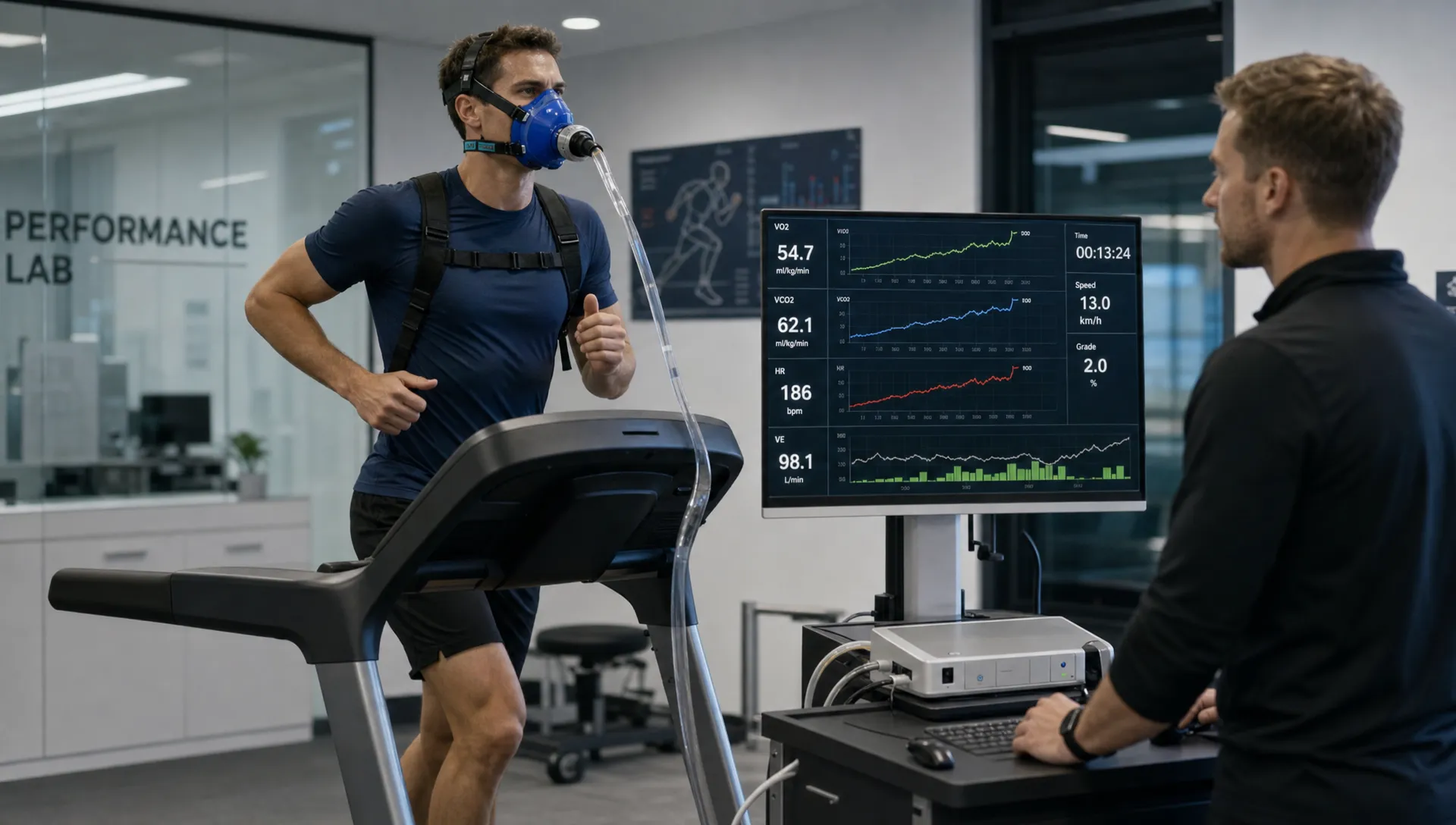
Guessing your VO2 max intensity from a watch, treadmill display, or generic heart rate chart can be misleading. Wearables can be useful for trends, but they are estimating. Lab-based testing gives a more precise picture of your current physiology.
A proper VO2 max test can identify your aerobic capacity, heart rate response, ventilatory thresholds, and training zones. That matters because two people with the same age and similar workout habits may need very different training intensities.
Testing also helps prevent the most common mistake: doing “hard” work that is too hard to recover from but not targeted enough to create the desired adaptation. With better data, your easy days can be truly easy, your hard days can be specific, and your program can become more efficient.
For runners and endurance-focused clients, Custom Fit offers more detail on VO2 max testing for runners in San Francisco, including how testing can inform pacing, zones, and smarter training decisions.
The smarter way to improve VO2 max
If your goal is to improve VO2 max, do not think only in terms of max-intensity workouts. Think in terms of the whole system that supports oxygen delivery and use.
That system includes your heart’s ability to pump blood, your blood’s ability to carry oxygen, your muscles’ ability to use oxygen, your mitochondria, your movement economy, and your recovery capacity. VO2 max intervals may stress the system, but Zone 2 training, threshold work, strength training, and nutrition help build it.
A complete approach often includes:
- Aerobic base training: Lower-intensity work that builds durability and metabolic efficiency.
- Strength training: Especially for runners and aging adults who need muscle, tendon capacity, and joint resilience.
- Targeted intervals: Used when the body is ready and the goal justifies the stress.
- Fueling and protein intake: Under-fueled athletes often struggle to adapt to hard training.
- Recovery planning: Sleep, deload weeks, and stress management are not optional extras.
This is where data-driven coaching becomes valuable. The workout that looks impressive on paper may not be the workout your body needs this week.
So, is training at VO2 max ever the right move?
Yes. Training at VO2 max is the right move when you have a specific performance or fitness goal, enough base training to support it, accurate zones, and a program that protects recovery. It is especially useful for endurance athletes and motivated exercisers who have already built consistency and need a targeted stimulus.
No, it is not the right move if you are injured, inconsistent, under-recovered, new to training, or using intensity as a shortcut for a missing foundation.
For most people, the best formula is not “go harder.” It is “train more precisely.” That may include VO2 max intervals, but only as one part of a complete plan.
Frequently Asked Questions
Can beginners do VO2 max training? Beginners can do interval training, but true VO2 max work is often unnecessary at first. Most beginners improve VO2 max through consistent aerobic exercise, strength training, and gradually increasing workload.
How do I know if I am actually training at VO2 max? The most accurate way is lab testing that identifies your VO2 max, thresholds, and training zones. Without testing, you can estimate based on pace, power, heart rate, and perceived exertion, but those estimates are less precise.
Is VO2 max training safe for older adults? It can be, but it depends on health status, training history, medications, and cardiovascular risk. Older adults should build gradually and consider medical clearance if they have risk factors or symptoms.
How long should VO2 max intervals be? Common intervals range from 1 to 5 minutes, with enough recovery to repeat high-quality efforts. Longer intervals are not automatically better if they cause form breakdown or excessive fatigue.
Can I improve VO2 max without high-intensity intervals? Yes. Zone 2 training, threshold training, weight loss when appropriate, improved movement economy, and consistent cardiovascular exercise can all improve VO2 max, especially in newer or returning exercisers.
Train hard when it matters, not all the time
At Custom Fit SF, VO2 max testing, personal training, nutrition coaching, recovery services, DEXA scans, and longevity testing can help turn your fitness plan into something measurable and individualized. If you want to know whether training at VO2 max belongs in your program, start with better data and a smarter plan.
The right intensity can change your fitness. The right timing makes it sustainable.