What Personalized Fitness Training Should Look Like in 2026


Personalized fitness training used to mean a trainer adjusted your workouts, remembered your goals, and pushed you harder than you would push yourself. In 2026, that definition is not enough.
The best programs now look more like an integrated performance and health system: objective testing, expert coaching, nutrition strategy, recovery planning, and ongoing measurement, all adapted to the realities of your life. For a busy professional in San Francisco, a physician looking for a trusted wellness partner, or someone investing seriously in longevity, personalization should be much more than a custom workout on a clipboard.
It should answer a simple question with increasing precision: what will help this person get fitter, healthier, and more resilient with the time, data, and physiology they actually have?
Personalized fitness training in 2026 is data-informed, not data-obsessed
The fitness industry has more data than ever. Wearables track sleep, heart rate, steps, strain, and recovery. Smart scales estimate body composition. Apps count macros, miles, reps, and minutes. Yet more data does not automatically produce better results.
The difference in 2026 is interpretation. A high-quality personalized fitness training program should use data to guide decisions, not overwhelm the client. The purpose is not to track everything forever. The purpose is to identify the few metrics that matter most for your goal, then translate those metrics into a plan you can execute consistently.
For most adults, the foundation still starts with the basics. The World Health Organization recommends at least 150 to 300 minutes of moderate aerobic activity per week, or 75 to 150 minutes of vigorous activity, plus muscle-strengthening work on two or more days. But those guidelines do not tell you how to train around knee pain, a 60-hour workweek, a high-stress travel schedule, or a goal of improving VO2 max while preserving lean mass.
That is where personalization matters. In 2026, a strong program should combine evidence-based training principles with individualized coaching, testing, and behavioral support.
It should start with a baseline before prescribing workouts
A truly personalized program should not begin with a random hard session. It should begin with an assessment.
The first step is understanding the client as a whole person: goals, training history, injuries, sleep patterns, stress load, nutrition habits, schedule constraints, medical considerations, and personal preferences. A founder training for longevity will need a different plan than a new parent trying to rebuild strength, an executive managing blood pressure, or an athlete returning from injury.
Objective testing can make the starting point clearer. Depending on the person and goal, a baseline may include body composition testing such as a DEXA scan, cardiovascular fitness testing such as VO2 max, metabolic testing, strength benchmarks, mobility screening, gait or movement analysis, and recovery indicators. These measurements help distinguish between what someone feels is happening and what is actually changing.
This is especially important for people who have tried generic fitness plans and felt stuck. A scale may not show improvements in lean mass. A wearable may show poor recovery without explaining why. A person may believe they are training hard enough, only to discover their cardiovascular work is not targeting the right intensity zones.
Custom Fit has written more specifically about personal training in San Francisco built around your data, and that concept is central to what training should look like in 2026. The goal is not testing for its own sake. The goal is to create a smarter starting point, then use follow-up measurements to adjust the plan.
The training plan should adapt like a living system
Once the baseline is clear, the program should be structured enough to create progress and flexible enough to respond to real life.
A well-designed training plan should include progressive strength training, cardiovascular conditioning, mobility work, and recovery planning. The exact balance depends on the client. Someone focused on fat loss and metabolic health may need a different mix than someone focused on muscle gain, endurance performance, bone density, or healthy aging.
The core training principles have not disappeared. Progressive overload, exercise selection, intensity, volume, frequency, and recovery still matter. The American College of Sports Medicine position stand on progression models in resistance training highlights how variables such as load, volume, rest periods, and exercise order can be manipulated to improve strength, power, hypertrophy, and muscular endurance.
What changes in 2026 is the feedback loop. A personalized plan should adjust when the client adapts, stalls, travels, gets sick, sleeps poorly, or changes goals. If strength is improving but recovery is declining, the program may need a deload. If VO2 max is stagnant, conditioning zones may need to be refined. If body composition is changing but energy is low, nutrition or training load may need attention.
This is where expert coaching still matters. The plan should not be a static PDF. It should be a system that evolves.
Nutrition should be integrated into training, not treated as an afterthought
Most people do not fail because they lack a workout. They fail because training, nutrition, stress, and schedule are pulling in different directions.
In 2026, personalized fitness training should include nutrition coaching when nutrition is relevant to the goal, which it almost always is. This does not mean everyone needs a strict meal plan or constant calorie tracking. It means the nutrition strategy should support the training objective.
For example, a client trying to gain lean mass needs enough total energy and protein to recover and build. A client trying to improve metabolic health may need a strategy for blood sugar stability, fiber intake, meal timing, and sustainable fat loss. A client training early in the morning may need guidance on fueling and hydration. A client who eats most meals in restaurants needs practical choices that fit business dinners and travel.
Protein is a useful example. The International Society of Sports Nutrition position stand on protein and exercise notes that protein intake and timing can influence training adaptations, especially for people engaged in resistance training. But the right target depends on body size, goal, appetite, medical context, and overall diet quality.
This is why access to qualified nutrition professionals, including registered dietitians when appropriate, is becoming a key differentiator. Personalized nutrition should be realistic, clinically responsible, and coordinated with the training plan.
Recovery should be prescribed with the same seriousness as exercise
In older fitness models, recovery was what happened when you were not training. In 2026, recovery is part of the program.
That includes sleep, rest days, stress management, mobility, soft tissue work, deload weeks, and the timing of hard training sessions. For high-performing professionals, this matters because the body does not separate work stress from training stress. A week of poor sleep, intense travel, and high-pressure meetings can change how much training stress someone can absorb.
Research continues to support the performance value of sleep. In a study of collegiate basketball players, sleep extension was associated with improvements in sprint time, shooting accuracy, reaction time, and mood. While not every client is a competitive athlete, the principle is relevant: recovery quality affects output, adaptation, and consistency.
A personalized program should therefore ask better questions than how hard did you work out? It should also ask: how well did you recover, and what should change because of it?
For some people, the answer may be a lower-intensity aerobic session instead of heavy lifting. For others, it may be breathwork, mobility, compression, sauna, massage, or simply a smarter sleep routine. The key is matching recovery tools to the person and the goal.
Measurement should focus on outcomes that matter
The bathroom scale is one data point, but it is often too blunt to guide a sophisticated program. Personalized fitness training in 2026 should measure outcomes that are more specific and more meaningful.
For strength-focused clients, that may include improvements in major movement patterns, grip strength, power, and lean mass. For metabolic health, it may include waist circumference, body composition, resting heart rate, glucose-related metrics when coordinated with a medical provider, or aerobic capacity. For longevity, it may include VO2 max, muscle mass, balance, mobility, and the ability to maintain performance across decades.
Cardiorespiratory fitness deserves special attention. A large study published in JAMA Network Open found that higher cardiorespiratory fitness was associated with lower long-term mortality among adults undergoing treadmill testing. This does not mean every person needs to train like an endurance athlete. It does mean that aerobic capacity is a meaningful health metric, not just a performance number.
The best programs use periodic reassessments to answer practical questions. Is lean mass increasing? Is body fat decreasing at a sustainable rate? Is aerobic capacity improving? Is the client recovering better? Are workouts becoming more efficient? Is the plan still aligned with the client’s life?
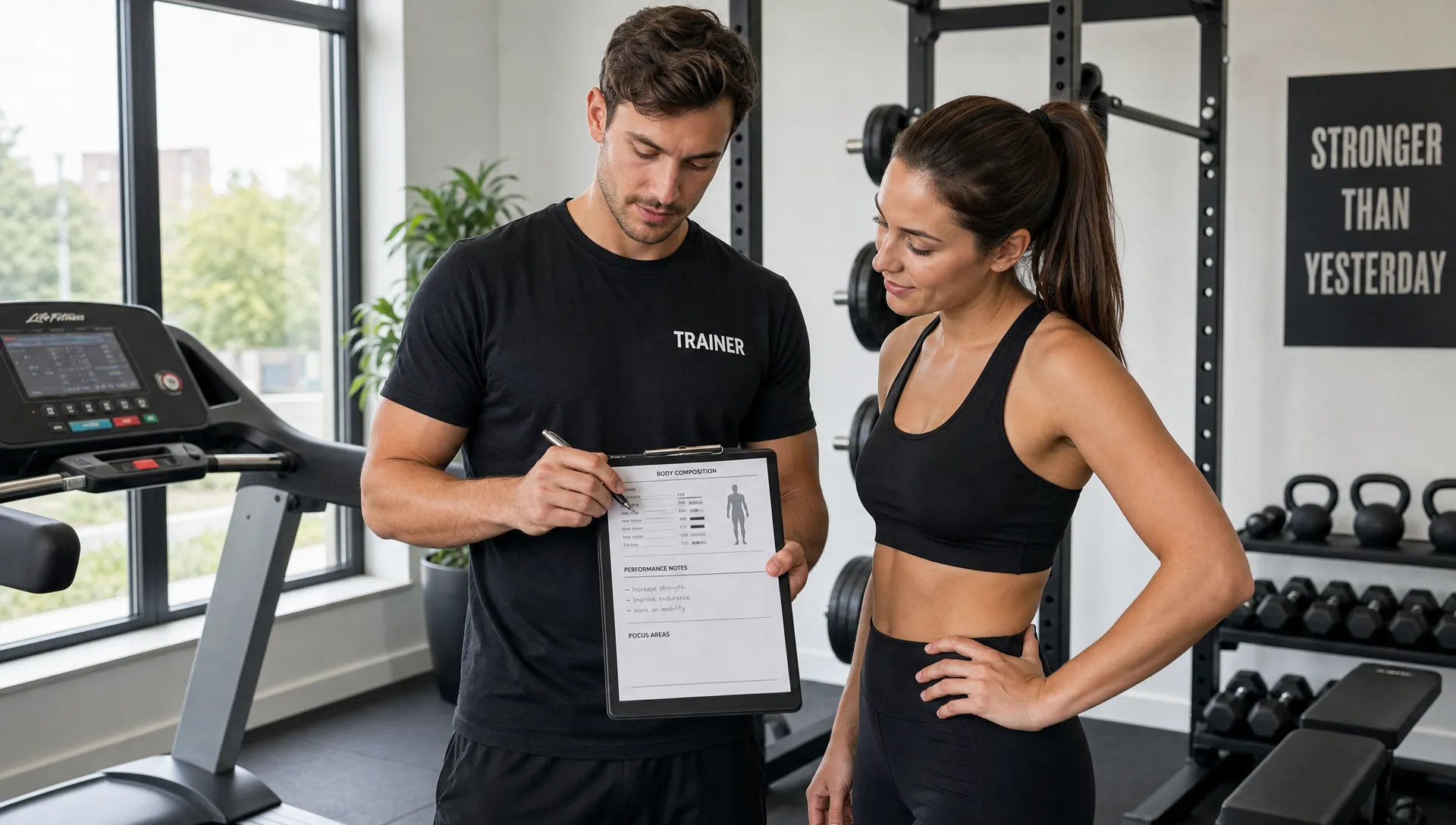
The human coach becomes more important, not less
As technology improves, it is tempting to assume that apps and algorithms will replace coaching. In reality, the opposite is more likely for people who want serious results.
Technology can suggest a workout. A coach can decide whether that workout is appropriate today. Technology can show declining sleep. A coach can help the client adjust training, nutrition, caffeine, travel habits, and evening routines. Technology can show that someone skipped sessions. A coach can identify whether the issue is motivation, schedule design, pain, intimidation, boredom, or unrealistic expectations.
This is especially important for busy professionals. The best program is not always the theoretically perfect program. It is the most effective program the client can actually perform consistently. Custom Fit has covered this challenge in its article on whether personal training is worth it for busy professionals, and it remains one of the most practical reasons to invest in coaching.
In 2026, a great trainer should be part exercise scientist, part strategist, part teacher, and part accountability partner. They should know how to push, when to pull back, and how to keep the client moving forward without burning them out.
Personalized training should fit the realities of San Francisco life
San Francisco clients often deal with dense schedules, demanding careers, variable commutes, frequent travel, and high cognitive load. A fitness plan that ignores those realities is not personalized, even if the exercises are customized.
In 2026, personalization should include calendar design. If a client only has three reliable training windows per week, the program should be built around those windows. If a client travels twice a month, the plan should include hotel gym options and recovery strategies for flights. If a client has unpredictable workdays, the plan should include minimum effective workouts that preserve momentum.
Major disruptions such as relocation can interrupt a routine. Tell your coach about upcoming changes so you can plan shorter sessions, alternative locations or a temporary schedule.
A good program should not require a perfect life. It should help you stay consistent inside an imperfect one.
It should connect fitness, healthcare, and longevity when appropriate
One of the biggest shifts in 2026 is the growing overlap between fitness, preventive health, and longevity medicine. Personal training is no longer only about aesthetics or short-term performance. For many clients, it is part of a broader strategy to maintain muscle, improve metabolic health, preserve independence, and increase healthspan.
This creates opportunities for collaboration with private practice doctors, concierge medicine groups, longevity clinics, and employee benefits teams. A fitness and testing partner can provide objective measures that support more informed conversations about exercise, body composition, aerobic fitness, and lifestyle change.
The key is scope and communication. Trainers and wellness professionals should not replace physicians, diagnose conditions, or manage medical treatment. But with the client’s consent, they can help implement exercise, nutrition, and recovery plans that complement clinical care.
For longevity-focused clients, the training program should emphasize strength, aerobic capacity, mobility, balance, body composition, and recovery. Custom Fit’s article on longevity personal training in San Francisco explores this healthspan-oriented approach in more depth.
For employers, the same principle applies. A meaningful wellness benefit should go beyond step challenges. It should help employees improve measurable health and fitness markers while providing expert support that fits demanding schedules.
How to evaluate a personalized fitness training program in 2026
If you are comparing options, look beyond the aesthetics of the facility or the intensity of the workout. A modern program should have a clear method.
A strong personalized fitness training program should include:
- A comprehensive baseline that includes goals, history, constraints, and relevant objective testing.
- A written plan that explains what you are doing, why you are doing it, and how progress will be measured.
- Progressive strength training that matches your ability, experience, and recovery capacity.
- Cardiovascular training that is targeted to your goals, not just random hard intervals.
- Nutrition guidance that supports your training, body composition, energy, and health objectives.
- Recovery strategies that account for sleep, stress, soreness, travel, and workload.
- Regular reassessment so the program changes as your body adapts.
- Qualified professionals who know when to collaborate with medical providers or refer out.
The most important sign is that the program feels specific. Not complicated, not performative, and not overloaded with metrics, but clearly designed for you.
What the first 90 days should look like
A modern training experience should have a logical ramp-up. The first few weeks are not just about sweating. They are about learning how your body responds.
Weeks 1 to 2: assessment and calibration
The early phase should establish baseline data, movement quality, training tolerance, and recovery patterns. The coach should learn how you move, how you schedule, what motivates you, and what obstacles are most likely to interfere. The client should learn the purpose of the plan and how success will be tracked.
Weeks 3 to 8: progression and habit formation
Once the baseline is clear, training intensity and complexity can increase. Strength work becomes more progressive. Conditioning becomes more targeted. Nutrition changes become more consistent. This is also when the coach should identify which habits produce the biggest return, because sustainable progress depends on repeatable behaviors.
Weeks 9 to 12: reassessment and refinement
By the end of the first 90 days, the program should have enough information to make smarter decisions. Body composition, strength, conditioning, energy, and adherence can be reviewed. The next phase should be based on evidence from the client’s own response, not assumptions.
This is the real promise of personalization: the plan gets better because it learns from you.
Frequently Asked Questions
What is personalized fitness training? Personalized fitness training is a coaching approach that adapts exercise, nutrition, recovery, and progress tracking to an individual’s goals, physiology, schedule, experience, and constraints. In 2026, the best versions use both objective data and expert coaching.
Do I need DEXA or VO2 max testing to have a personalized plan? Not always, but these tests can be valuable when body composition, metabolic health, cardiovascular fitness, performance, or longevity are priorities. Testing helps create a clearer baseline and can make progress easier to measure.
How often should a personalized fitness plan change? The plan should be reviewed continuously and adjusted when your data, schedule, recovery, or goals change. Major reassessments often make sense every 8 to 12 weeks, although the exact timeline depends on the program.
Is personalized training only for advanced athletes? No. Beginners often benefit the most because they need the right starting point, safe progression, accountability, and guidance. Personalization helps prevent the common mistake of doing too much too soon or following a plan that does not fit.
Can personalized fitness training support longevity goals? Yes. A longevity-focused plan can target strength, lean mass, aerobic capacity, balance, mobility, metabolic health, and recovery. It should complement medical care when health conditions or clinical goals are involved.
Build a smarter training plan for 2026
Personalized fitness training in 2026 should be precise, practical, and deeply human. The best programs use data to guide decisions, expert coaches to interpret that data, and sustainable systems to help clients stay consistent in real life.
If you are in San Francisco and want a more data-driven approach to fitness, nutrition, testing, and recovery, Custom Fit offers personal training, nutrition coaching, DEXA scans, VO2 max testing, recovery programs, memberships, and group classes designed around measurable progress. Ask about current new client options and find out what a truly personalized plan could look like for your goals.