What Is the Best Longevity Test? Why One Number Is Never Enough


Most people looking into longevity testing are searching for one magic number.
They want to know their biological age. They want to know if their bloodwork is “good.” They want to know whether their VO₂ max is high enough, whether their body fat is healthy, or whether their genetics say anything useful about how they should eat and train.
The problem is that no single test can answer the full longevity question.
A DEXA scan can show your body composition, visceral fat, lean mass, and bone density, but it cannot tell you how well your cardiovascular system performs. Bloodwork can show what is happening metabolically, hormonally, and inflammatory-wise, but it cannot tell you how much muscle you carry or how efficiently you use oxygen. A VO₂ max test can show your aerobic fitness, but it cannot explain your cholesterol, glucose control, nutrient status, or genetic predispositions.
That is why the best longevity testing approach is not one test. It is a layered baseline.
The Four Categories That Matter Most
A strong longevity assessment should answer four major questions:
- What is your body made of?
- How fit is your cardiovascular system?
- What is happening internally through your blood markers?
- Would genetic context or a current strength baseline better guide your next steps?
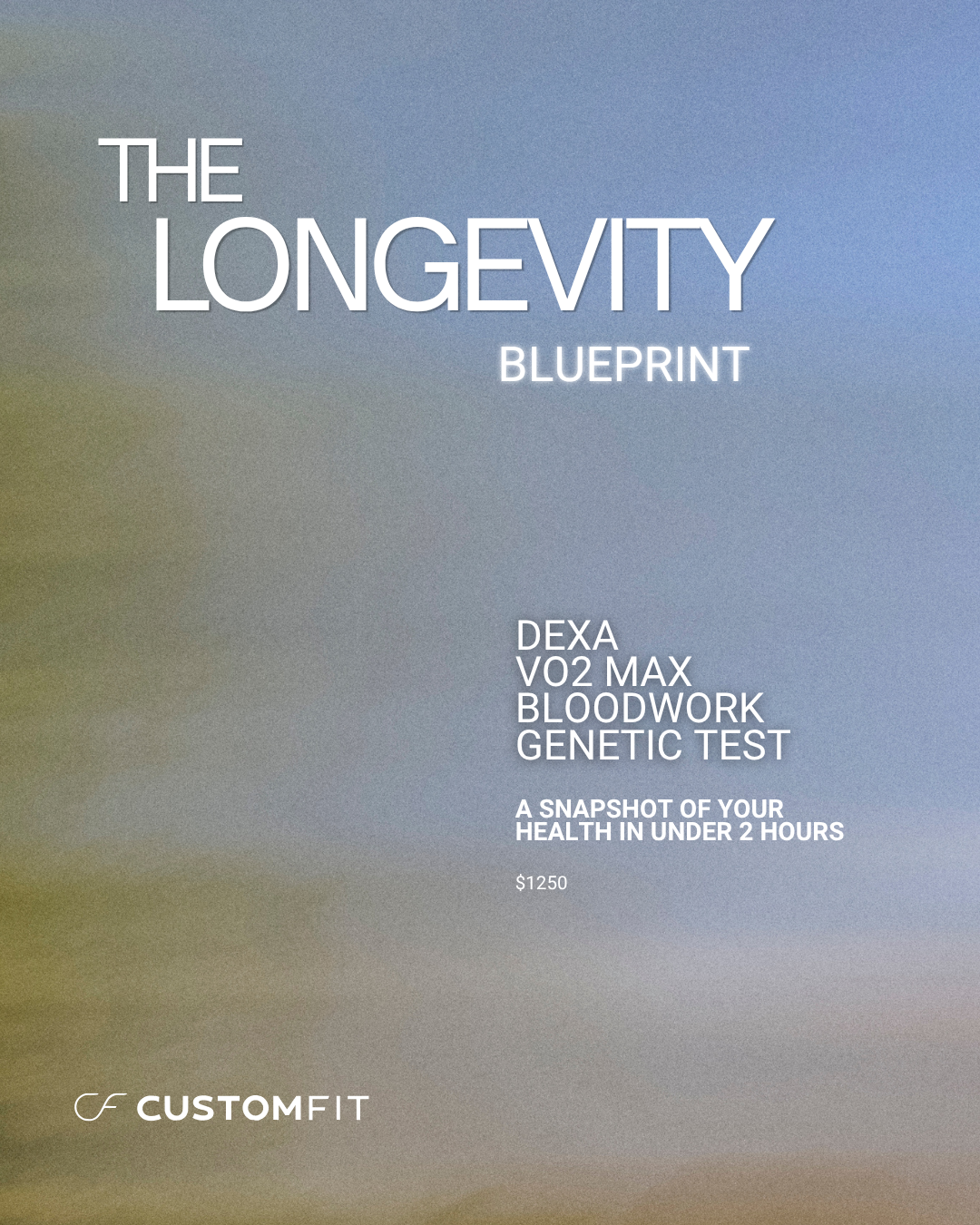
At Custom Fit, the Longevity Blueprint is built around those four categories.
It includes a DEXA scan, VO₂ max test, advanced bloodwork, your choice of Nutrigenomix genetic testing or Vault Kinetics strength testing, and a review with a Registered Dietitian. The goal is not just to collect data. The goal is to turn that data into a practical plan.
Why DEXA Matters for Longevity
The scale is one of the least useful tools for understanding long-term health.
Two people can weigh the same amount and have completely different health profiles. One may have more lean mass, better bone density, and lower visceral fat. The other may have less muscle, higher abdominal fat, and greater long-term metabolic risk.
A DEXA scan gives you a clearer picture by measuring:
- Total body fat percentage
- Lean muscle mass
- Visceral fat
- Bone density
- Regional body composition
- Left-right muscle differences
For longevity, this matters because muscle, fat distribution, and bone health all influence how well you age.
The goal is not simply to be lighter. The goal is to maintain or build muscle, reduce excess visceral fat, preserve bone density, and understand where your body composition actually stands.
Why VO₂ Max Matters
VO₂ max measures how well your body takes in, transports, and uses oxygen during intense exercise.
In simple terms, it is a measure of your cardiovascular engine.
For athletes, VO₂ max helps guide endurance training. For everyday adults, it provides insight into cardiovascular fitness, metabolic efficiency, and long-term resilience.
A low VO₂ max does not mean you are doomed. It means you have a measurable target.
That is the value of testing. Once you know your baseline, you can build a smarter training plan around the specific system that needs improvement.
Why Bloodwork Matters
Bloodwork gives insight into what is happening beneath the surface.
Depending on the panel, this may include markers related to:
- Glucose regulation
- Cholesterol and lipids
- Inflammation
- Liver and kidney function
- Thyroid function
- Nutrient status
- Hormonal patterns
- Cardiovascular risk factors
This matters because someone can look fit externally while still having internal markers that need attention.
Bloodwork helps identify priorities. For one person, the biggest opportunity may be improving insulin sensitivity. For another, it may be lipid management, vitamin D, inflammation, or recovery.
Why Genetic Testing Matters
Genetic testing is often misunderstood.
It does not tell you your destiny. It does not replace bloodwork. It does not mean there is one perfect diet for your DNA.
What it can do is provide context.
Nutrition-focused genetic testing can help identify tendencies related to caffeine metabolism, vitamin needs, fat and carbohydrate response, inflammation, recovery, and exercise adaptation.
The key is reviewing genetic results alongside actual current data.
A genetic predisposition matters more when it lines up with bloodwork, body composition, symptoms, or performance goals. Used correctly, genetics can help refine the plan rather than replace the basics.
Why the Tests Are Stronger Together
The power of longevity testing is not in collecting more numbers. It is in connecting the numbers.
For example:
If someone has high visceral fat on DEXA, elevated fasting glucose on bloodwork, and low VO₂ max, the plan should likely prioritize aerobic conditioning, strength training, nutrition structure, and improved metabolic health.
If someone has low lean mass and poor protein intake, the plan may need to focus on progressive strength training, protein distribution, and adequate energy intake.
If someone has strong body composition but poor cardiovascular fitness, the training plan should not only focus on lifting. It should include structured aerobic development.
If someone has genetic tendencies related to vitamin metabolism and matching bloodwork abnormalities, nutrition can become more precise.
That is the difference between isolated testing and an actual blueprint.
Who Should Consider Longevity Testing?
Longevity testing is especially useful for:
- Adults who want a clear health baseline
- Busy professionals who want objective data
- People starting a serious fitness or weight-loss phase
- People on GLP-1 medications who want to preserve muscle
- Athletes and recreational athletes who want performance data
- Adults over 40 who want to train for healthspan
- Anyone who feels like they are guessing with nutrition, training, or recovery
You do not need to be an elite athlete. You just need to want better information.
What to Do With the Results
The most important part of testing is what happens afterward.
A good longevity assessment should help you answer:
- What should I prioritize first?
- Should I focus more on fat loss, muscle gain, cardiovascular fitness, or blood markers?
- How should I adjust my training?
- How should I adjust my nutrition?
- What should I retest, and when?
- Which numbers actually matter for my goals?
At Custom Fit, the Longevity Blueprint is designed to connect testing with action. Because DEXA, VO₂ max, bloodwork, your choice of Nutrigenomix genetic testing or Vault Kinetics strength testing, nutrition coaching, and personal training all exist under one roof, the results can be translated into a practical plan instead of sitting in a report.
The Bottom Line
The best longevity test is not one test.
It is a complete baseline that looks at body composition, cardiovascular fitness, metabolism, blood markers, and genetic context together.
That is what makes the Longevity Blueprint different. It is not just a data dump. It is a structured way to understand where you are now, what matters most, and what to do next.
If you want to stop guessing and start building your health with objective data, the Longevity Blueprint is the place to start.