How Nutrition Coaching Programs Create Habits That Last



You may know what a balanced lunch looks like and still struggle to eat one between meetings. Effective nutrition coaching programs address that gap between knowing and doing. They help turn useful choices into repeatable routines, so eating well depends less on having extra time, energy or motivation.
For busy San Francisco professionals, the goal is not to follow a perfect menu indefinitely. It is to develop habits that survive office days, restaurant meals, travel and changing schedules. The most valuable coaching teaches you how to build those habits, adjust them when circumstances change and eventually maintain them with less support.
Why nutrition coaching programs build routines before rules
A meal plan tells you what to eat. A habit-building approach also considers what happens immediately before the meal: where you are, what food is available and which decisions you have already made.
Suppose you regularly reach lunchtime without anything prepared. More nutrition information may not solve the problem. A better starting point could be setting aside tomorrow’s lunch while putting away dinner. That connects a desired action to something you already do.
The value of nutrition coaching programs is often in identifying these practical connections rather than adding more food rules. A coach can help distinguish a knowledge gap from a scheduling problem, an unrealistic target or an environment that makes the intended behavior difficult.
Habit formation also takes time. In Phillippa Lally and colleagues’ real-world habit formation study, participants repeated an eating, drinking or activity behavior in a consistent context. The time needed for behaviors to approach automaticity varied substantially. Missing one opportunity did not materially disrupt the process in that study.
The practical lesson is to look for increasing ease and consistency, not a universal deadline such as “21 days.”
Connect a meal habit to a reliable cue
A cue is an event or situation that prompts an action. Useful cues are specific enough to recognize and stable enough to occur regularly. “Eat better tomorrow” is an intention. “After I clear the dinner table, I will put tomorrow’s lunch in a container” identifies an opportunity to act.
Start with a cue that already exists. Finishing breakfast, unpacking groceries or closing your laptop for lunch may work better than an unfamiliar reminder that is easy to dismiss.
Research on planning supports this distinction. Peter Gollwitzer and Paschal Sheeran’s meta-analysis of implementation intentions examined plans that specify when, where and how someone will act. Across different goal domains, these plans helped translate intentions into behavior. That does not prove every eating routine will succeed, but it supports making the next action concrete.
In practice, nutrition coaching programs can help you choose a cue that fits your actual day and test whether it works. If evening preparation consistently fails because you get home late, a weekend grocery cue or a recurring lunch break may be more reliable.
The cue should support eating, not override hunger or medical needs. A routine is a helpful default, not an instruction to ignore your body.
Make one behavior easy enough to repeat
An ambitious habit can fail simply because it requires too much effort on an ordinary Tuesday. Cooking several new recipes, changing breakfast and tracking every meal at once creates multiple opportunities for friction.
Choose one behavior that addresses a recurring problem. If afternoon hunger leads to unplanned grazing, the first experiment might be making lunch more satisfying. If you regularly miss lunch entirely, protecting time to eat may come before optimizing ingredients.
It helps to define both a normal version and a fallback version:
| Situation | Normal version | Practical fallback |
|---|---|---|
| Preparing tomorrow’s lunch | Pack leftovers after dinner | Choose a nearby lunch option before the workday starts |
| Eating breakfast before an early meeting | Prepare a familiar breakfast at home | Keep a convenient option available that meets your needs |
| Cooking after a long workday | Make a planned meal | Assemble a meal from ready-to-eat staples |
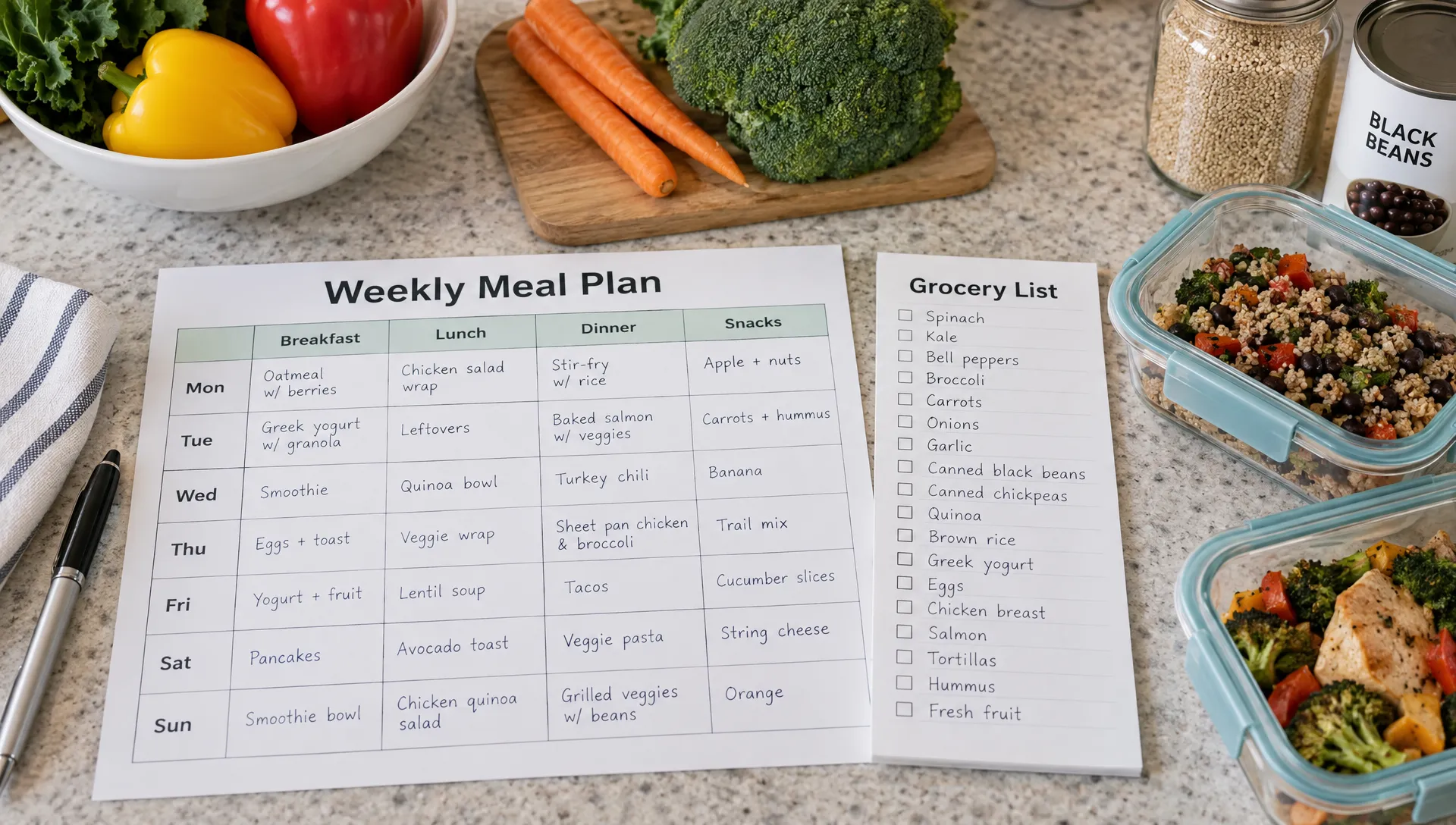
| Shopping for the week | Follow a short grocery list | Restock the few foods that support your main habit |
These are examples to adapt, not a prescribed meal plan. Food preferences, allergies, access and health conditions will affect the right choices.
Well-designed nutrition coaching programs help make the fallback useful enough to preserve the behavior. A backup lunch is not a failure because it differs from your original recipe. It solves the more important problem of having a workable meal when time is short.
Make routines flexible enough for real life
Lasting habits need consistency, but consistency does not require identical meals. You might maintain a dependable lunch break while changing what you eat according to appetite, availability or your training schedule.
This distinction matters for professionals whose calendars vary. An office-day routine may not transfer automatically to a conference, a remote-work day or a week of client dinners. Instead of expecting one plan to work everywhere, identify the part worth preserving: making time to eat, choosing a satisfying meal or preparing one useful item ahead.
Household routines can provide another anchor. A shared food-preparation routine can fit meal planning into family life. Letting a child help wash produce, for example, can make dinner preparation part of time together rather than a separate task.
The aim of nutrition coaching programs should be to help you adapt a behavior without abandoning its purpose. On a travel day, that might mean locating an accessible meal before your first meeting rather than attempting your usual home routine.
Flexibility makes the habit more portable. It also avoids turning one disrupted day into a reason to stop.
Measure the behavior, not just the outcome
Outcome goals matter, but they do not always explain whether a habit is becoming easier. A single weigh-in, for example, cannot tell you whether your lunch routine is becoming more reliable.
Behavior measures give you something actionable to review. You might record how often you packed lunch, whether a fallback was available or how much effort the routine required. A simple note can be enough; tracking does not need to become another demanding project.
Review the circumstances as well as the frequency. “I prepared lunch three times” is useful. “I prepared lunch whenever leftovers were available, but not when I had to cook something separate” reveals a specific design problem.
This is where supportive nutrition accountability can complement habit building. Check-ins are most useful when they help interpret what happened and choose an adjustment, rather than merely score compliance.
The feedback loop in nutrition coaching programs should connect observations to decisions. If a routine requires less prompting and survives a busy week, that is meaningful progress. If it remains difficult, the next step may be a smaller action or a better cue, not a stricter target.
Treat disruptions as a redesign problem
Illness, deadlines and travel will interrupt even a well-established routine. The useful question is what made the behavior difficult and what would make restarting easier.
Separate a one-off interruption from a repeating obstacle. Missing meal preparation during an unusually late flight may need no major change. Missing it every Thursday because of a standing evening commitment suggests the plan needs a different preparation window.
A recovery plan can be simple: return to your next usual meal, restock one helpful food or use the fallback you selected earlier. There is no need to compensate for a disrupted eating day by skipping meals or adopting rigid restrictions.
Nutrition coaching programs can also help you recognize when the problem is outside the habit itself. Persistent fatigue, distress around eating or symptoms affecting food intake deserve appropriate professional assessment rather than more reminders.
As you review setbacks, keep the language descriptive. “The meeting ran through lunch and I had no backup” gives you something to change. “I have no discipline” does not. The first explanation leads to a practical adjustment; the second often leads to an unnecessarily harsher plan.
Choose a program that prepares you for independence
Before enrolling, ask how the program approaches behavior change. Can the professional help you define a realistic action, identify barriers and create alternatives? How will you evaluate progress beyond following instructions?
You should also understand who provides the guidance. Registered Dietitians can provide individualized nutrition care, including medical nutrition therapy within their scope. A coach’s title alone does not establish equivalent clinical qualifications, so ask about credentials when health conditions or complex dietary needs are involved.
The strongest nutrition coaching programs should leave you more capable of making decisions yourself. Useful signs of readiness include being able to recognize your cues, choose workable alternatives and restart after interruptions without needing someone to approve every meal.
If exercise performance is part of your goal, coordinating nutrition support with training may help avoid conflicting advice. Custom Fit’s discussion of integrated nutrition and fitness programs explores that broader approach.
Testing can complement a goal review, but it does not measure habit automaticity. If you include body composition testing, Custom Fit DEXA scans are performed by Registered Dietitians or Exercise Physiologists. Clients work with professionals who understand nutrition, exercise physiology and body composition, not simply receive an automated scan report. The purpose is informed interpretation alongside your goals, not replacing everyday behavior review with a measurement.
Frequently Asked Questions
How long does it take to build a lasting nutrition habit? There is no universal timeline. The behavior’s complexity, its cue and your circumstances all matter. Look for reduced effort and more reliable repetition rather than treating a fixed number of days as a guarantee.
Are nutrition coaching programs just meal plans? No. Habit-focused support also addresses preparation, routines, barriers and recovery after disruptions. A meal plan can be one tool, but the larger goal is helping you make useful decisions when the original plan is unavailable.
Do I need to track everything I eat? Not necessarily. Tracking should answer a useful question. Recording one target behavior may be sufficient, while more detailed monitoring may be appropriate for some goals under professional guidance.
What if my schedule changes every week? Build around the cues that remain dependable and create alternatives for different settings. A reliable grocery restock or a preselected lunch option may be easier to maintain than a fixed cooking schedule.
Build a routine you can keep
A useful first step is to identify one recurring eating challenge and the moment when it usually begins. Bring that example to a nutrition professional, along with your schedule, preferences and health priorities.
Explore nutrition coaching at Custom Fit in San Francisco, where nutrition coaching and Registered Dietitians are available alongside personal training. Ask how support can help you build a realistic routine and recognize when you are ready to maintain it more independently.