Group Classes or Private Coaching: Which Fits You Best?
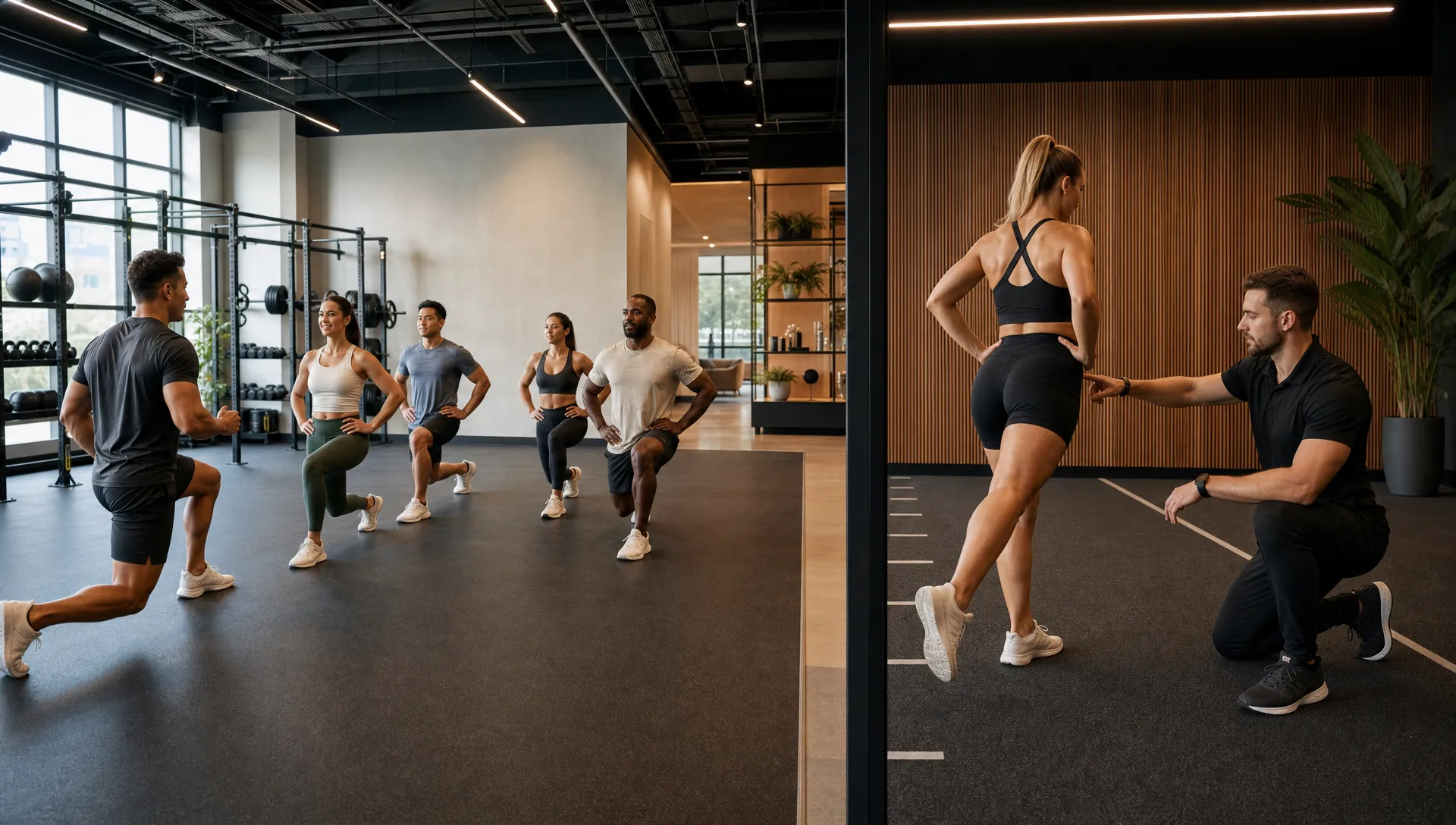


Choosing between group classes and private coaching is not really about which format is “better.” It is about which environment helps you train consistently, progress safely, and stay aligned with your actual goals.
For a busy San Francisco professional, founder, physician, or parent, the best fitness plan is rarely the most theoretically perfect one. It is the one you can repeat during a demanding week, adjust when life gets complicated, and trust enough to keep showing up.
The stakes are higher than aesthetics. The Physical Activity Guidelines for Americans recommend that adults get 150 to 300 minutes of moderate-intensity aerobic activity each week, plus muscle-strengthening work at least two days per week. The World Health Organization makes similar recommendations, emphasizing both cardiovascular and strength training for long-term health.
So the question becomes: what format will help you actually do the work?
The quick answer: match the format to the problem
Group classes are usually a strong fit if your biggest challenge is consistency, motivation, decision fatigue, or lack of energy when training alone. They provide structure, a scheduled time, a coach-led session, and a sense of momentum from the room.
Private coaching is usually a stronger fit if your biggest challenge is personalization. That might mean you have a specific body composition goal, an injury history, a performance target, complex schedule constraints, or health data that needs to be translated into a practical plan.
A hybrid approach often works best: private coaching sets the strategy, while group classes help you build weekly training volume and community.
Where group classes shine
Group classes are powerful because they remove friction. You do not have to design the workout, choose exercises, set the pace, or motivate yourself through every set. You show up, follow the coach, and benefit from the energy of the group.
That matters because consistency is the foundation of results. A perfectly optimized plan that you complete once a week will usually underperform a well-designed class routine that you attend three times a week. For many busy adults, the class calendar itself becomes the accountability system. If the class is scheduled, it feels more like a meeting with yourself than a vague intention to “work out later.”
This is especially useful for people who make decisions all day. Executives, doctors, attorneys, finance professionals, and business owners often do not need more choices at 6 p.m. They need a clear next step. Group classes create that next step.
They also offer social reinforcement. You may not become best friends with everyone in class, but being around other people who are working hard can raise your effort, mood, and follow-through. If you have ever trained harder because the person next to you kept going, you already understand the effect.
Group classes tend to fit especially well when your goals include:
- Building a consistent exercise habit
- Improving general strength and conditioning
- Reducing stress after work
- Replacing random workouts with a structured routine
- Enjoying more energy from training with others
- Staying active without managing every detail yourself
If consistency is your main obstacle, you may also find it helpful to read how gym classes help busy adults stay consistent, especially when your schedule is full and decision fatigue is real.
When group classes may not be enough
Group classes are efficient, but they are not always specific enough. A class has to serve multiple people at once, which means the workout is designed around a shared goal, not your exact movement history, recovery capacity, or performance target.
That is not a flaw. It is simply the nature of the format.
If you are dealing with recurring back pain, post-injury limitations, major strength imbalances, or uncertainty about your form, you may need more individualized coaching before making classes your main training method. The same is true if you feel lost during class, constantly modify movements on your own, or leave sessions feeling beat up rather than better.
Group classes can also become limiting when your goals become more precise. If you want to improve your VO2 max, change body composition, train for a mountain objective, rebuild strength after time away, or coordinate exercise with nutrition and recovery, you may need a more tailored strategy.
The best group class experience still requires good coaching. Look for coaches who explain the purpose of the session, offer regressions and progressions, watch movement quality, and create an environment where you feel challenged but not pressured to ignore your body.
Where private coaching shines
Private coaching is about precision. Instead of fitting yourself into the workout, the workout is built around you.
A coach can assess how you move, understand your schedule, clarify your goals, and adjust the plan based on your response. That level of personalization is especially valuable if you have limited training time. When you only have two or three sessions per week, every session needs to count.
Private coaching can also help bridge the gap between knowing what to do and doing it. Many high-performing professionals already understand that exercise matters. The issue is not information. It is implementation. A coach helps you turn intent into scheduled action, then adapts the plan when travel, work stress, poor sleep, or soreness interfere.
This is one reason personal training can be worth considering for demanding schedules. If you are weighing the investment, this guide on whether personal training is worth it for busy professionals offers a deeper look at the decision.
Private coaching tends to be the better fit when your goals include:
- Improving strength with excellent technique
- Training around pain, injury history, or movement limitations
- Changing body composition with a coordinated plan
- Preparing for a race, hike, sport, or event
- Using data from DEXA, VO2 max, or metabolic testing
- Building a plan that fits an unpredictable calendar
- Getting direct accountability from a coach who knows your goals
Research supports the long-term value of strength training as part of a complete health plan. A 2022 systematic review and meta-analysis in the British Journal of Sports Medicine found that muscle-strengthening activities were associated with a lower risk of all-cause mortality and several major noncommunicable diseases. The takeaway is not that everyone needs the same program. It is that strength training deserves a consistent, well-structured place in your week.
Choose based on your primary goal
The easiest way to decide is to stop comparing formats in general terms and start with your main goal for the next 90 days.
If your goal is consistency, group classes may be the best starting point. They give you structure, energy, and a recurring appointment. If you already know how to move safely and simply need to show up more often, classes can be a practical solution.
If your goal is body composition change, private coaching may provide a stronger foundation. Body composition is influenced by training, nutrition, recovery, stress, sleep, and adherence. Classes can support calorie expenditure and strength, but a personalized plan can better coordinate the variables that drive change.
If your goal is performance, private coaching often makes more sense. Performance goals require progression, testing, recovery management, and intelligent adjustments. Whether you care about strength numbers, endurance capacity, VO2 max, or longevity metrics, you need more than hard workouts. You need a plan.
If your goal is stress relief, group classes can be excellent. The combination of movement, music, coaching, and social energy can create a clear transition between work mode and recovery mode. For many professionals, that emotional reset is one of the biggest benefits of training.
If your goal is confidence, either format can work, depending on what builds confidence for you. Some people feel more comfortable learning privately before joining a class. Others feel less self-conscious in a group because the attention is not entirely on them.
If your goal is follow-through, private coaching may help if you repeatedly start and stop. A coach can make the plan more realistic, reduce ambiguity, and adjust expectations before you fall off completely. For a deeper look at this, see how personal coaching fitness plans improve follow-through.
Consider your personality and schedule
Fitness is not just physiology. It is behavior design.
If you are energized by a room full of people, group classes can make training feel enjoyable rather than obligatory. If you are competitive in a healthy way, the group setting may bring out your best effort. If you prefer clear boundaries between work and personal time, booking classes in advance can protect your calendar.
If you are more private, analytical, or goal-specific, private coaching may feel more productive. You can ask detailed questions, move at your own pace, and spend session time on the things that matter most for your body.
Schedule also matters. Group classes work well when class times match your life. If you can reliably attend the same two or three classes each week, the format can become almost automatic. But if your calendar changes constantly due to patients, client meetings, travel, or family obligations, private coaching may offer more strategic flexibility.
Coaching can reduce the planning burden when your schedule is demanding. Look for support that addresses the specific obstacles keeping you from training consistently.
The hybrid option: often the most realistic answer
Many people do not need to choose one format forever. They need the right combination for the season they are in.
A hybrid model might look like private coaching once or twice per week, plus group classes for additional conditioning, mobility, or strength exposure. The coach helps set the plan and monitor progress, while classes provide volume, variety, and community.
This can work especially well for people who want expert guidance but also enjoy the energy of training with others. It can also be useful if you are transitioning from rehab to regular training, returning after a long break, or trying to build confidence before joining more classes.
The key is coordination. If your private sessions and classes are completely disconnected, you may accidentally do too much of one thing and not enough of another. For example, stacking multiple high-intensity classes on top of heavy strength sessions may compromise recovery. A coach can help you decide which classes support your goals and which ones to limit.
Use data when the decision is not obvious
If you are unsure which format is right, objective data can clarify the next step.
A DEXA scan can help you understand body composition beyond the scale. VO2 max testing can give insight into cardiovascular fitness. Nutrition coaching can identify whether your training is being supported by adequate protein, energy intake, hydration, and recovery habits.
This is where a data-driven fitness environment becomes valuable. Instead of guessing whether you need more classes, more strength work, more recovery, or better nutrition support, you can make the decision from a clearer baseline.
Data does not replace coaching judgment, but it improves the conversation. It helps turn vague goals like “get in better shape” into measurable priorities.
A simple decision framework
Before choosing group classes, private coaching, or a hybrid approach, ask yourself these questions:
- What result do I want in the next 90 days? If the goal is general consistency, classes may be enough. If the goal is specific and measurable, coaching may help.
- Do I need movement modifications? If pain, injury history, or technique concerns are present, private coaching is often the safer starting point.
- Do I thrive with social energy or focused attention? Your personality matters because enjoyment affects adherence.
- How much planning do I want to do myself? Classes remove workout design. Coaching removes both design and much of the strategic decision-making.
- Does my goal require nutrition, recovery, or testing support? If yes, private coaching or a data-driven hybrid plan may be more effective.
The right answer may change over time. You might start with coaching, shift into more group classes once you feel confident, then return to private coaching when your goals become more advanced.
How Custom Fit SF can help
At Custom Fit SF, the goal is not to force everyone into the same training format. The goal is to help you choose the right level of structure, personalization, and support for your life.
For some clients, that means group classes that make exercise consistent and enjoyable. For others, it means personal training, partner training, nutrition coaching, DEXA scans, VO2 max testing, recovery support, or a more comprehensive plan built around measurable progress.
If you are a busy professional, physician, founder, or someone who simply wants to stop guessing, the best next step is to identify the format that removes your biggest barrier. If the barrier is motivation, group classes may be the answer. If the barrier is complexity, private coaching may be the answer. If the barrier is both, a hybrid approach may be the most realistic path.
Frequently Asked Questions
Are group classes enough to get in shape? Yes, group classes can be enough for many people, especially if your goal is general fitness, consistency, strength, conditioning, and stress relief. They work best when you attend regularly and the class format matches your ability level.
Is private coaching better than group classes? Private coaching is not automatically better, but it is more personalized. It is usually the stronger choice if you have a specific goal, injury history, movement concerns, or want a plan built around testing, nutrition, and recovery.
Can I combine group classes and private coaching? Yes. A hybrid approach can be very effective. Private coaching can guide your strategy and technique, while group classes help you stay consistent and add training volume.
What should beginners choose first? Beginners can start with either format. If you feel confident moving in a group and the class is beginner-friendly, group classes can be a great start. If you feel unsure about form, intensity, or modifications, private coaching may help you build a safer foundation.
How do I know when to switch from classes to coaching? Consider switching or adding coaching if you plateau, feel recurring discomfort, stop seeing progress, need more accountability, or develop a more specific goal such as body composition change, performance improvement, or longevity testing.
Ready to find your best fit?
The best training format is the one that helps you show up, train well, recover properly, and progress with confidence.
If group energy keeps you consistent, start there. If personalized strategy is what you need, private coaching may be the better investment. If you want both structure and precision, combine them.
Custom Fit SF offers a data-driven approach to fitness, nutrition, testing, and recovery so you can choose the path that fits your goals and your life, not someone else’s template.