What to Look For in a Personal Training Facility


A studio can look impressive on a tour and still be frustrating to use. Attractive equipment tells you little about whether appointments start on time, trainers communicate well or your program changes when progress stalls. For a busy San Francisco professional, choosing a personal training facility means evaluating the entire service, not just the room where you exercise.
The strongest candidates make their process understandable before you commit. They explain who will coach you, how appointments work, what your fees cover and how decisions about your training are made. They can also tell you what happens when you travel, need to reschedule or require support outside a trainer’s scope.
Use the initial conversation, a visit during your intended workout hours and the written agreement to check those details. Your goal is not to find the studio with the longest amenity list. It is to find one that can consistently deliver the help you actually need.
Evaluate the personal training facility as a service, not just a space
Start by asking the team to describe your first month. A clear answer should cover an initial conversation about your goals, an appropriate assessment, a starting plan and a process for reviewing how training is going.
Then ask what happens between appointments. Does your trainer record exercises, loads and relevant feedback? If another coach covers a session, can they access the information needed to continue your plan? You do not need elaborate software, but you should expect continuity rather than repeated introductions and improvised workouts.
A well-run personal training facility should explain how it keeps your program consistent while adjusting it to your response, preferences and availability. “Every workout is different” is not, by itself, evidence of personalization.
Evaluate the individual coach separately from the business. Relevant experience, communication style and the ability to explain exercise choices matter more than an impressive personal fitness résumé. Custom Fit’s guide to choosing a fitness personal trainer for your goals can help you assess that relationship.
Ask for a concrete example: How would the team adjust a client’s plan after missed sessions, persistent fatigue or several weeks without progress? Listen for a reasoning process, not a guaranteed outcome.
Visit during the hours you would actually train
A quiet midday tour cannot tell you whether the studio works well before your workday. Visit near your likely appointment time and observe the conditions you would experience regularly.
Notice whether trainers can access the equipment their clients need without repeated delays. Check whether conversations are audible, walkways stay clear and staff remain focused on the person they are coaching. Shared equipment is not inherently a problem; unmanaged congestion is.
The practical value of a personal training facility depends partly on whether you can use it consistently. Ask about recurring appointments, peak-hour availability and how far ahead sessions must be booked. Also clarify whether “availability” means an appointment with your preferred coach or any coach on the team.
If you work in SoMa, map the actual door-to-door trip to Custom Fit’s San Francisco studio and the other locations you are considering. Test the route at your intended training hour, including walking, transit transfers or parking. A trip that looks manageable on a map may not fit a short lunch break.
Ask about travel weeks and schedule changes before purchasing a package. A policy that suits someone with a predictable calendar may be difficult for a client who frequently travels or handles last-minute meetings.
Check safety standards and professional boundaries
Look for relevant, verifiable trainer credentials and current CPR/AED training. Ask how staff respond to an emergency, where emergency equipment is located and how equipment problems are reported. A confident answer should describe procedures rather than rely on reassurance.
Your initial screening should also address relevant health history, current symptoms and exercise experience. Depending on the circumstances, a trainer may recommend medical clearance or coordination with a treating clinician. Coaching should not involve diagnosing injuries, prescribing medication or promising to treat disease.
A responsible personal training facility knows when to adapt exercise and when to refer you to another professional. Be cautious if staff dismiss persistent pain or present the same demanding workout as appropriate for everyone.
The 2020 WHO physical activity guidelines published in the British Journal of Sports Medicine recommend aerobic activity alongside muscle-strengthening activity on at least two days per week for adults. A useful coaching conversation considers your overall week, including activity outside paid sessions, rather than treating every appointment as an isolated event.
The same boundaries apply to nutrition. Ask who provides guidance and what their qualifications allow them to do. General habit coaching and individualized medical nutrition therapy are different services; clients with medical nutrition needs should have access to an appropriately qualified clinician.
Look for measurement that changes the plan
Progress tracking should answer a practical question: Is the program helping you achieve the outcome you care about? Depending on your goals, useful measures might include exercise performance, aerobic capacity, attendance, daily function or how well you tolerate training.
Ask the team what it measures, why that measure matters and what would trigger a change in your program. More testing is not automatically better. A baseline is useful only when someone can interpret it and connect it to an appropriate next step.
A data-driven personal training facility should be able to explain how a result influences training frequency, exercise selection or progression. It should also distinguish a meaningful trend from normal variation.
Ask who interprets advanced testing
DEXA scans can provide information about body composition, while VO2 max testing assesses aerobic fitness. These tests answer different questions and should not be treated as interchangeable indicators of health.
At Custom Fit, DEXA scans are performed by Registered Dietitians or Exercise Physiologists. Clients work with professionals who understand nutrition, exercise physiology and body composition, rather than simply receiving an automated scan report. That professional context matters when interpreting results and discussing realistic changes.
For strength goals, ask how the coach progresses training over time. A 2023 systematic review and network meta-analysis of resistance-training prescriptions found that many approaches improved strength, with higher-load prescriptions ranking highest for that outcome. The takeaway is not that everyone should immediately lift heavy weights, but that programming should match the goal and progress appropriately.
Compare the full cost and the written terms
A session price is only one part of the financial comparison. Find out whether you also need a membership and whether assessments, testing, nutrition appointments or recovery services carry separate charges. Do not assume that services offered in the same building are included in the same package.
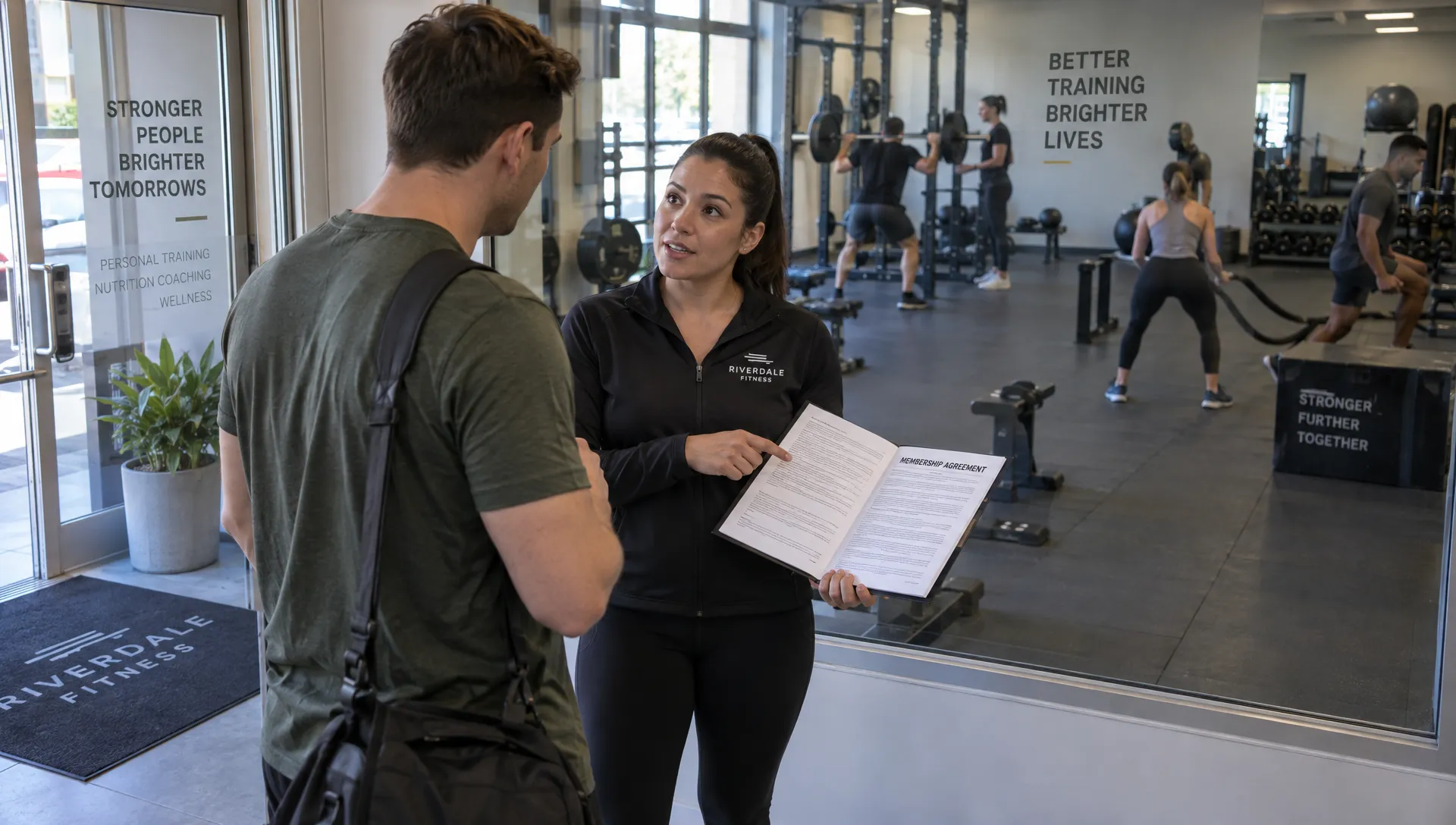
Ask for the complete agreement before paying. It should make session duration, expiration dates, cancellation deadlines and recurring charges understandable. If a term is unclear, request clarification in writing rather than relying on a verbal assurance.
Before committing to a personal training facility, understand what happens if your preferred trainer leaves, your schedule changes or you need to pause. Those situations can matter more than a small difference in the advertised session rate.
Use these questions to uncover the actual commitment:
- What is required beyond the session fee? Clarify membership charges and any separately billed services.
- When do purchased sessions expire? Check how travel, illness and extended absences are handled.
- What triggers a cancellation charge? Ask about notice periods and rescheduling options.
- How does the agreement end or renew? Confirm notice requirements, automatic renewals and refund terms.
Custom Fit’s explanation of what should be included in a personal training package offers additional context for comparing inclusions. Compare equivalent services, not just the largest package or lowest advertised rate.
Use evidence to compare your shortlist
After visiting two or three studios, write down what each one demonstrated. This prevents a friendly tour or attractive interior from outweighing unresolved questions about the service.
Use a simple comparison table. Mark an item as confirmed only when you have a specific answer, an observed example or a written policy.
| Area to compare | Useful question | Evidence to look for |
|---|---|---|
| Coaching continuity | How does another trainer continue my plan? | A clear process for recording and sharing relevant training information |
| Appointment access | Can I book the hours I need consistently? | Actual availability at your intended training times |
| Progress reviews | When will we reassess the plan? | A stated review process tied to your goals |
| Professional scope | Who handles needs outside exercise coaching? | Clear qualifications and referral boundaries |
| Financial commitment | What will I pay and under what terms? | Written inclusions, fees and cancellation policies |
The best personal training facility for you is the one that performs well on your priorities, not necessarily the one with the most services. Someone seeking dependable strength coaching may value appointment continuity more than recovery amenities. A client coordinating care with a physician may place greater emphasis on professional scope and consent-based communication.
Before choosing a facility, ask about qualifications, communication, pricing and scheduling. Clear answers help you understand the service before committing.
Treat pressure to sign immediately, unexplained fees and guaranteed transformations as reasons to pause. A credible team should be comfortable letting you understand the commitment first.
Frequently asked questions
Is a more expensive studio necessarily better? No. Higher prices may reflect location, staffing, facilities or added services. Assess whether those differences improve the coaching and access you need, then compare the total cost under equivalent terms.
Should I choose a facility that offers testing? Choose testing when it answers a relevant question and qualified staff can explain how the result informs your plan. It is not a substitute for consistent coaching, sensible progression or reliable appointment access.
How can I tell whether a personal training facility will suit a busy schedule? Check real appointment availability, travel time, cancellation rules and the process for maintaining your plan during travel. Visit at your intended workout hour rather than relying only on a quiet tour.
What should a physician or benefits manager ask before recommending a studio? Verify qualifications, professional boundaries, referral procedures and how information is shared with client consent. Also clarify eligibility, billing and reporting expectations instead of assuming a consumer membership covers an organizational arrangement.
Take the next step with clear expectations
Custom Fit offers personal training, partner training, nutrition coaching, longevity testing and recovery services in San Francisco, including access to Registered Dietitians. Ask the team which services fit your goals and which are included in the option you are considering.
Before selecting a personal training facility, leave the conversation knowing who will coach you, when you can train, how progress will be reviewed and what you will pay. Those answers provide a firmer basis for your decision than amenities alone.