What Do Training Sessions Cost Beyond the Hourly Rate?



If you spend several sessions training with a personal trainer each month, the hourly rate is only part of your budget. Membership requirements, cancellation rules, assessment fees and the time spent getting to the studio can change what those appointments actually cost.
Compare your total monthly cost with the number of sessions you realistically expect to attend. Then check what the fee includes, which extras are optional and whether the schedule fits your working week.
For San Francisco professionals, a cheaper appointment across town may be less practical than a more expensive one you can attend consistently.
Calculate the all-in cost first
Start with this calculation:
Monthly training payments + required fees + chosen add-ons + transportation costs = total monthly cash cost.
Divide that total by your expected completed appointments to estimate your effective cost per session. Keep time commitment alongside this calculation rather than assigning your personal time an arbitrary dollar value.
Separate recurring charges from one-time expenses. An initial assessment affects your first month differently from a membership fee charged throughout the year. A package paid upfront also creates a different cash-flow commitment than monthly billing, even if the advertised session price is identical.
Check what “monthly” means. Eight appointments per calendar month are not quite the same commitment as two appointments every week, which averages roughly 8.7 per month across a year. Ask whether billing follows a calendar month, a four-week cycle or a fixed package of visits.
What is included in sessions training with a coach?
A session price is easier to evaluate when you know what happens outside the appointment. Some arrangements cover only supervised exercise. Others include planning, progress reviews or guidance for independent workouts. Neither structure should be assumed from the price alone.
Ask who develops your program, how it changes over time and whether the trainer provides anything for days you exercise independently. Clarify whether communication between appointments is included, limited or separately billed.
Session length also matters. A 45-minute appointment and a 60-minute appointment are different purchases, but extra minutes do not automatically mean better coaching. Establish whether warm-ups, reviews and exercise instruction happen within the booked time.
You are comparing the scope of a service, not simply buying minutes. A clear description of responsibilities makes it easier to identify whether a higher quote includes useful support or additional services you do not need.
Identify fees that can change the quote
When comparing sessions training at different studios, request an itemized quote. The categories below are questions to ask, not charges every provider necessarily imposes.
| Cost category | What to clarify before paying |
|---|---|
| Facility access | Is gym access included during appointments? Does independent use require a membership? |
| Onboarding | Is an initial consultation or assessment included or separately billed? |
| Cancellations | What notice is required, and when does a missed visit count as used? |
| Package restrictions | Do sessions expire, roll over or allow transfers? |
| Testing | Is testing required, optional or included in the quoted price? |
| Additional services | Are nutrition coaching, recovery services or classes separate purchases? |
Cancellation and expiration terms deserve particular attention if your work involves travel or unpredictable meetings. A package discount loses value when appointments expire unused.
If access and coaching are bundled, understanding how gym memberships with personal trainers work can help you separate the membership obligation from the training commitment. Ask about renewal, pauses and notice requirements before signing.
See how an advertised rate changes in practice
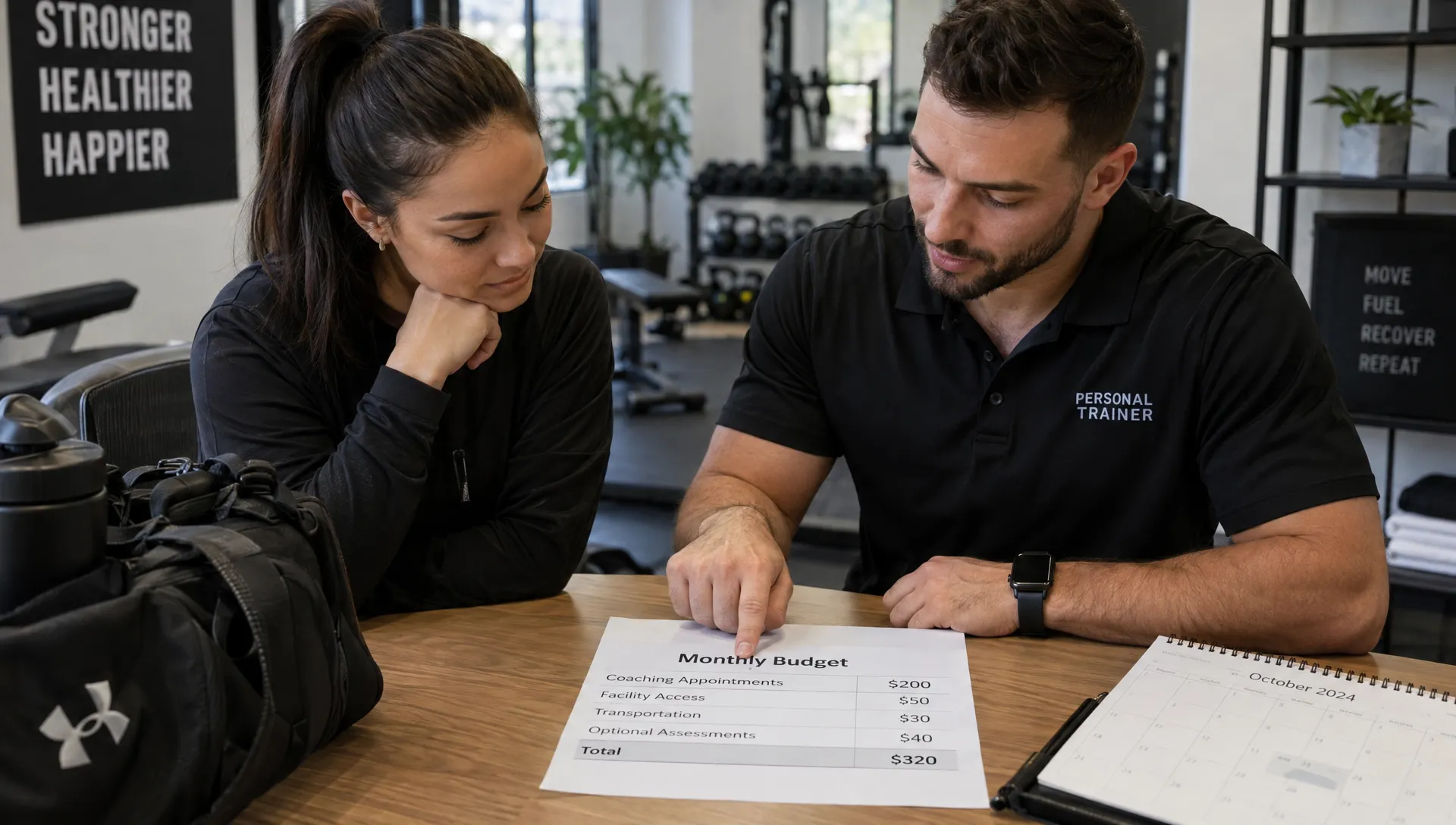
Consider this hypothetical four-week budget. These figures illustrate the calculation only; they are not Custom Fit prices or estimates of typical San Francisco rates.
| Expense | Illustrative amount |
|---|---|
| Eight appointments at $120 each | $960 |
| Required monthly facility fee | $80 |
| Monthly transportation allowance | $40 |
| Total budget | $1,080 |
With all eight appointments completed, the effective cash cost is $135 per attended session, rather than the advertised $120.
If you complete seven sessions training with the coach because one appointment is forfeited under the cancellation policy, that same $1,080 budget works out to about $154 per attended session. This example holds the transportation allowance fixed and assumes the missed appointment receives no credit.
The lesson is not that packages are a poor choice. It is that attendance and contract terms affect value as much as a headline discount. Compare packages using a realistic month, including your usual travel and scheduling constraints, rather than assuming every week will go perfectly.
Count travel and scheduling friction
Eight sessions training at a studio can also mean eight round trips. A one-hour appointment with 30 minutes of combined travel occupies at least 90 minutes before changing or showering. Across eight visits, that is 12 hours of calendar time.
If you work in SoMa, compare the trip to Custom Fit at the hour you would actually train. A route that looks manageable at midday may fit poorly between an early meeting and an evening commitment. Verify the studio address, appointment availability and access arrangements before purchasing a package.
Also consider what happens when your preferred time is unavailable. A standing appointment may reduce scheduling effort, but only if it matches your real availability.
A useful comparison includes both the monthly cash total and the weekly time requirement. The lowest quoted rate is not necessarily the lowest-cost option if getting there repeatedly causes missed appointments.
Separate useful assessments from optional extras
Testing can answer specific questions, but it should have a purpose within your plan. DEXA can assess body composition, while VO2 max testing evaluates cardiorespiratory fitness. Neither should be treated as an automatic prerequisite for every beginner.
Custom Fit DEXA scans are performed by Registered Dietitians or Exercise Physiologists. Clients work with professionals who understand nutrition, exercise physiology and body composition, rather than simply receiving an automated scan report.
When budgeting for sessions training toward a specific goal, ask what decision an assessment would change. Would the result inform exercise intensity, nutrition guidance or the way progress is evaluated? Ask whether professional interpretation is included and what would justify repeating the test.
Apply the same reasoning to recovery services and nutrition coaching. They may address a genuine need, but availability does not make every service necessary. Distinguish required costs from recommendations, then decide which optional services belong in your budget.
Reduce spending without removing the support you need
The most useful saving may come from changing how coaching is delivered, not simply finding the smallest hourly number.
Partner training can spread coaching costs when two people have compatible goals and availability. Confirm the actual quote and how the trainer divides attention. Do not assume it costs exactly half as much as private coaching or includes the same service.
Another option is combining supervised appointments with independent exercise. You might spend fewer sessions training under direct supervision once you have a program and technique you can manage independently. That decision should reflect your experience, confidence and goals, not just a package promotion.
A systematic review and network meta-analysis published in the British Journal of Sports Medicine found that a range of resistance-training prescriptions improved strength compared with no exercise. It evaluated exercise programs, not personal-training prices, so it does not establish how many paid appointments you need.
For a more specific discussion of scheduling, review how to decide how many personal training sessions you need. Build the purchase around the support required to carry out your plan.
If an employer is paying, separate coaching from event costs
Employee benefits managers need a different denominator: cost per participating employee and, when appropriate, cost per completed appointment. Purchased capacity alone can make an underused benefit look more valuable than it is.
Clarify eligibility, booking access, cancellation responsibility and what attendance information the employer receives. Health information should not be treated as routine participation reporting.
For a company retreat or wellness event, keep coaching separate from venue hire, catering and entertainment. Services such as corporate-event champagne-pyramid displays from Luuk Broos Events belong in the event-production budget, not the training rate. Separating those categories lets you compare fitness proposals without unrelated event expenses distorting the per-person figure.
When reporting participation, completed sessions training with a coach are a more useful measure of actual use than the number of appointments purchased. They still do not, by themselves, prove improved employee health or productivity.
Get the terms in writing before committing
Request a written summary covering the appointment length, number of visits, included services, required fees and cancellation policy. It should also explain package expiration, renewal and any conditions for pausing or ending the arrangement.
Ask for two totals: what you owe to get started and what you would pay in a normal ongoing month. This prevents an introductory offer from becoming the only number you remember.
If your schedule is uncertain, compare a smaller commitment with a discounted package. Paying a higher rate for appointments you actually use can be less expensive than buying a larger package that expires partly unused.
Keep the comparison focused on your goal. More testing, more appointments or a longer contract are not automatically better value. The useful package is the one that provides appropriate support on terms you understand.
Frequently asked questions
Is $300 a month enough for a personal trainer? It depends on the provider’s rates, session length and required fees. At a hypothetical $100 per appointment, $300 buys three sessions training with a coach before any additional charges. It would not cover the same frequency at a higher rate. Ask what the full budget purchases rather than judging the amount in isolation.
Are training packages always cheaper than individual appointments? They may offer a lower advertised session price, but check expiration, cancellation rules and required memberships. Compare the cost of appointments you expect to complete, not just the number included in the package.
Should testing be included in personal training? Not necessarily. Ask which question the test answers, who performs and interprets it and how the findings would affect your plan. An optional assessment should be presented separately from required coaching costs.
What is the best number to compare between studios? Start with total monthly cash cost divided by expected attended appointments. Then compare service scope, scheduling practicality and the amount of independent support included. Price alone cannot capture those differences.
Ask for a complete training quote
Custom Fit offers personal training, partner training, nutrition coaching, testing and recovery services. When you inquire, ask which services are included in the proposed arrangement and which are separate.
Bring your preferred schedule, goals and monthly budget. Request an itemized quote and written terms so you can choose based on the full commitment, not just the hourly rate.