What a DEXA Body Scan Shows That a Scale Cannot
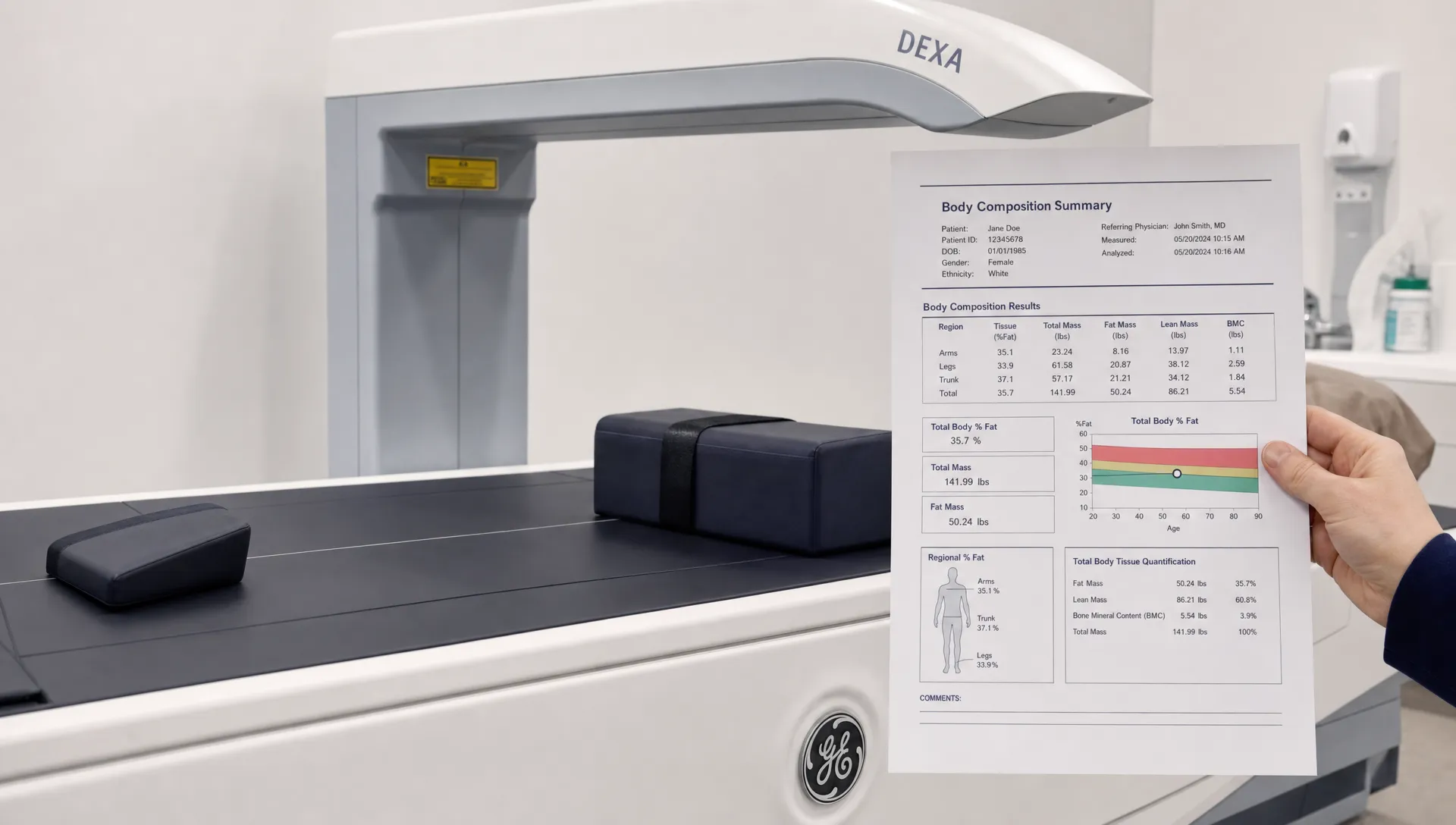


A DEXA body scan answers the question your bathroom scale cannot: what is your weight actually made of? Two people can weigh the same, and one may carry more lean muscle, less visceral fat and stronger bones than the other. Even your own weight can stay flat while your body composition changes in a meaningful way, especially if you are strength training, improving nutrition or returning to fitness after a demanding work stretch.
For busy professionals in San Francisco, the difference matters. A scale gives one number. A DEXA scan gives a map of fat, lean mass and bone mineral density, then turns that map into better decisions about training, food, recovery and health goals.
What a DEXA body scan measures that your scale cannot
A DEXA scan, short for dual energy X-ray absorptiometry, uses two low dose X-ray energy levels to estimate different tissues in the body. Instead of treating your body as one total weight, it separates that weight into clinically useful categories.
A scale measures gravitational load. A DEXA body scan estimates how much of that load is fat mass, lean mass and bone mineral content. That distinction is why DEXA is widely used in research and clinical settings for body composition assessment. A review in the Journal of Diabetes Science and Technology describes DEXA as one of the commonly used methods for assessing body composition because it provides total and regional estimates rather than a single number.
| What you want to know | Bathroom scale | DEXA scan |
|---|---|---|
| Total body weight | Yes | Yes |
| Body fat percentage | No | Yes |
| Lean mass | No | Yes |
| Muscle balance by region | No | Yes |
| Visceral fat estimate | No | Yes |
| Bone mineral density | No | Yes |
| Where changes are happening | No | Yes |
This is the central advantage: the scan shows what changed, not just whether the total went up or down.
Why scale weight can be misleading
Scale weight is sensitive to water, glycogen, salt intake, digestion, menstrual cycle changes and time of day. If you eat more carbohydrates after a hard training block, your muscles store more glycogen, and each gram of glycogen is stored with water. The scale may rise even though your fitness is improving.
A DEXA body scan helps separate temporary weight shifts from body composition changes. If your weight is up three pounds but lean mass increased and fat mass decreased, that is very different from gaining three pounds of fat. If your weight is down but lean mass fell faster than fat mass, that may signal underfueling, poor recovery or a training plan that needs revision.
That nuance is especially useful for people who have relied on body weight as their main success metric. Weight loss can be helpful in some contexts, but it is not automatically the same as better health, better performance or a better physique.
For a deeper comparison of common metrics, Custom Fit has a separate guide on why DEXA gives more actionable body composition data than BMI.
Body fat percentage is only the beginning
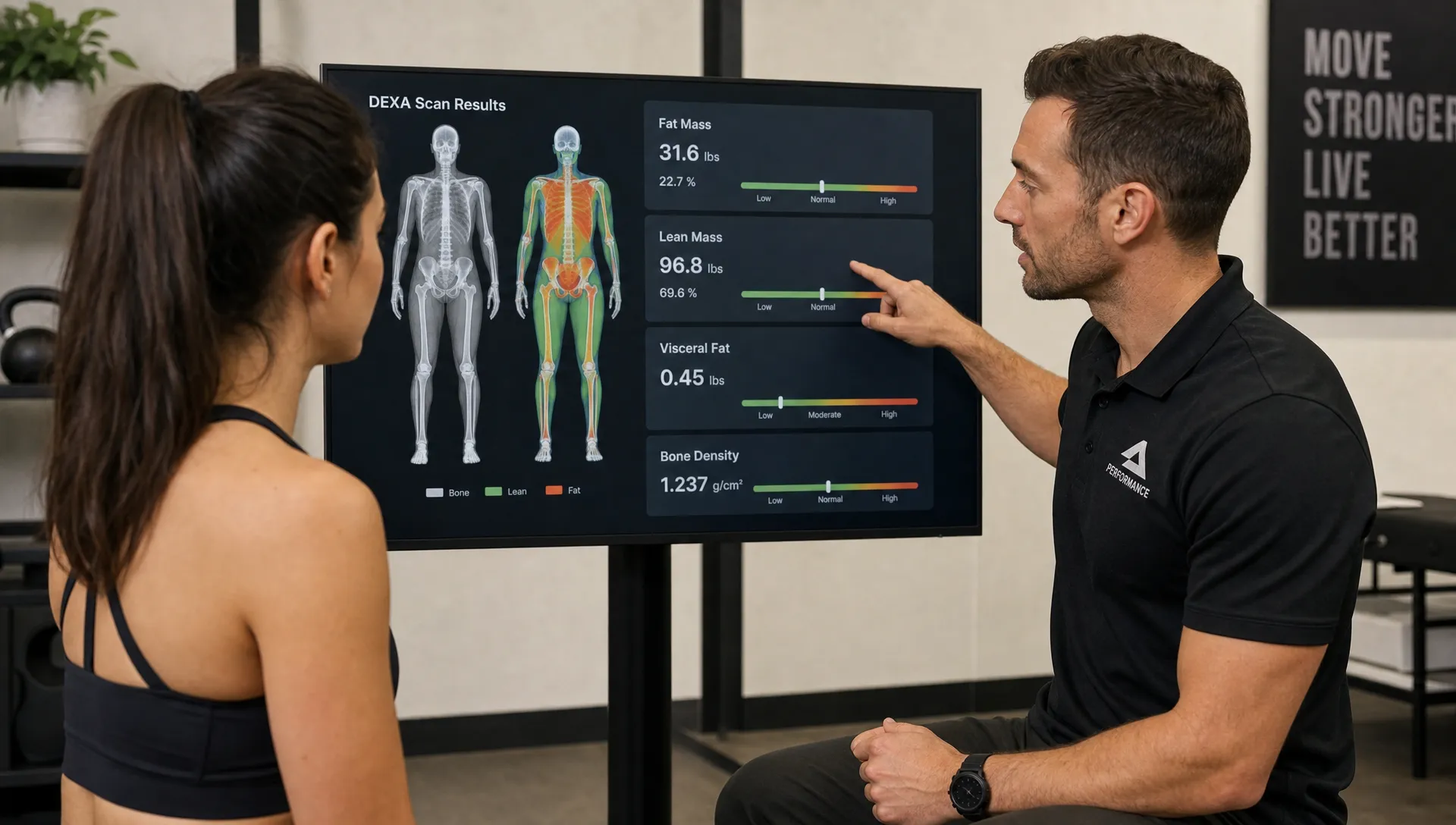
Body fat percentage is one of the most familiar numbers on a DEXA report, but it is not the whole story. A useful scan also shows how fat is distributed across the body. That matters because fat stored in different locations can have different implications.
Subcutaneous fat sits under the skin. Visceral fat is stored deeper in the abdomen around internal organs. A scale cannot distinguish the two, and neither can a mirror with much precision.
A DEXA body scan can estimate visceral adipose tissue, which gives you a more specific view of metabolic risk than body weight alone. Jean-Pierre Després, in a Circulation review on body fat distribution and cardiovascular disease risk, explains that abdominal and visceral fat are closely tied to cardiometabolic health. In plain English, where fat is stored can matter as much as how much total fat someone carries.
That does not mean one scan diagnoses disease. It means your body composition data can help you and your health team decide whether nutrition, training and lifestyle changes are moving the right markers.
Lean mass shows whether your plan is building the body you want
Lean mass includes muscle, organs, connective tissue and body water. In fitness settings, the most actionable part is usually skeletal muscle trend. Are your legs gaining lean mass from strength training? Is one side lagging after an injury? Are you losing muscle during a calorie deficit?
A DEXA body scan gives regional lean mass estimates, so you can see more than total muscle trend. For example, a runner may discover lower body lean mass is strong but upper body lean mass is low. A desk-bound executive who lifts twice a week may find that total weight has not changed, but lean mass is rising and fat mass is falling.
This matters beyond appearance. The European Working Group on Sarcopenia in Older People highlights low muscle strength and muscle quantity as key components of sarcopenia, a condition associated with aging, frailty and worse health outcomes. You do not need to be elderly for muscle to matter. Preserving and building lean mass is one of the most practical long-term health strategies available.
Bone density is the hidden metric most people forget
Many people think of DEXA only as a body fat test, but the technology is also closely associated with bone mineral density assessment. Bone health is often invisible until there is a problem, which is why having a baseline can be useful, especially for adults who are aging, training intensely, dieting aggressively or returning from periods of inactivity.
A scale cannot show whether weight loss is accompanied by a concerning drop in lean mass or whether your bone density deserves more attention. A DEXA body scan brings these hidden metrics into the conversation.
For some clients, bone density data reinforces the value of resistance training, adequate protein, calcium, vitamin D and a nutrition plan that does not chronically underfuel the body. For others, it may be a prompt to discuss results with a physician, especially if the scan suggests a medical follow-up is appropriate.
At Custom Fit, scan interpretation stays within the proper scope of fitness and nutrition coaching, and clients are encouraged to work with their medical provider when results call for clinical evaluation.
The real value is expert interpretation, not just the report
Data is only useful if someone can help you act on it. This is where Custom Fit’s approach differs from simply receiving an automated scan report.
Custom Fit DEXA scans are performed by Registered Dietitians or Exercise Physiologists. That means clients work with professionals who understand nutrition, exercise physiology and body composition, not just the mechanics of running a scan. They can help translate the numbers into practical next steps, such as whether to prioritize fat loss, muscle gain, maintenance, fueling strategy, strength programming or recovery.
For many San Francisco clients, this is similar to how they already treat financial data. A total account balance is useful, but it does not reveal allocation, risk or performance drivers. Tools such as anonymous portfolio benchmarking tools help investors compare what is underneath the surface. DEXA does the same for your body composition: it shows the components behind the headline number.
If you work near the Financial District or commute through SoMa, scheduling testing around a workday can be more realistic than driving across the Bay for a one-off scan. You can learn more about testing and training options at Custom Fit’s San Francisco studio.
When a DEXA scan is most useful
You do not need to scan constantly. The best use of DEXA is to establish a baseline, make a focused plan and retest after enough time has passed for meaningful adaptation.
A DEXA scan is especially useful when you are trying to answer a specific question:
- Are you losing fat while preserving lean mass?
- Is your strength program increasing muscle in the areas you care about?
- Is your visceral fat moving in the right direction?
- Is one side of your body carrying less lean mass after an injury?
- Did a nutrition change improve body composition, or only scale weight?
A DEXA body scan can also be helpful before starting a new training block, weight loss phase, performance plan or longevity program. For high-performing professionals, the appeal is efficiency: better data reduces guesswork.
Retesting frequency depends on the goal. Many people benefit from scanning every 8 to 16 weeks during an active body composition phase. If the goal is general monitoring, a less frequent cadence may be enough.
How to prepare for more consistent results
DEXA is precise, but your habits before the scan can still affect interpretation. The goal is not to manipulate the number. The goal is to make each scan comparable to the last one.
For best consistency, try to scan under similar conditions each time. Morning appointments, similar hydration, similar food timing and avoiding unusually hard exercise right before testing can make trends easier to interpret. Wear comfortable clothing without metal when possible, and follow the instructions provided by the facility performing the scan.
A DEXA body scan is most powerful when paired with notes about your training, nutrition, sleep and recovery. If fat mass drops but performance collapses, the plan may be too aggressive. If lean mass rises but visceral fat does not improve, nutrition quality, alcohol intake, stress or sleep may deserve attention.
After your scan, it helps to understand the report section by section. Custom Fit’s guide on how to read your DEXA scan results explains the major metrics and what to look for over time.
What the scale still does well
The scale is not useless. It is inexpensive, fast and helpful for spotting broad trends. For some goals, weekly average weight can still provide useful feedback. The problem begins when weight becomes the only feedback.
A scale cannot tell you whether your training is building muscle, whether your deficit is too aggressive, whether fat loss is coming from the areas that matter most or whether your bone density deserves attention. It can confirm that total mass changed, but it cannot explain the quality of that change.
That is why DEXA and scale weight work best as different tools. The scale can track short-term trend. DEXA can periodically reveal what is driving the trend.
Frequently Asked Questions
Is a DEXA body scan the same as weighing yourself? No. A scale measures total weight, while DEXA estimates fat mass, lean mass, visceral fat and bone mineral density. The scale tells you how much you weigh, but DEXA shows what that weight is made of.
How often should I get a DEXA scan? Many people retest every 8 to 16 weeks during a focused training or nutrition phase. If you are only monitoring long-term health trends, you may not need to scan as often.
Can DEXA show whether I am gaining muscle? Yes, DEXA estimates lean mass by region, which can help show whether your training plan is increasing lean tissue in your arms, legs or trunk over time.
Does visceral fat matter if my weight is normal? It can. Some people have a normal body weight but still carry more abdominal or visceral fat than expected. This is one reason body composition testing can be more informative than weight alone.
Who reviews DEXA scans at Custom Fit? Custom Fit DEXA scans are performed by Registered Dietitians or Exercise Physiologists, so clients receive context from professionals trained in nutrition, exercise physiology and body composition.
See what your scale is missing
If you are training hard, changing your nutrition or investing in long-term health, you deserve better feedback than a single number on the floor. A DEXA scan can show whether your plan is building muscle, reducing fat, improving visceral fat and supporting the kind of progress you actually want.
To get expert interpretation with your results, you can book a DEXA scan in San Francisco with Custom Fit and turn your body composition data into a smarter plan.