How a Postpartum Trainer Can Support a Safe Return to Exercise



Returning to exercise after childbirth is not simply a matter of restarting your old workout. Healing, interrupted sleep, pelvic floor symptoms and the physical demands of caring for a baby all affect what feels manageable. A postpartum trainer can help you rebuild strength and confidence with a plan that responds to those changes, rather than treating a six-week appointment as permission to resume everything at once.
The goal is a sustainable return to activities you value, whether that means comfortable stroller walks, lifting your baby or eventually running again. Good coaching also recognizes when you need medical care or pelvic health physical therapy instead of another exercise modification.
Medical clearance is a starting point, not a complete training plan
There is no single return-to-exercise timeline that fits every birth. Recovery after an uncomplicated vaginal delivery can differ substantially from recovery after a cesarean birth, significant tearing, infection or other complications.
The American College of Obstetricians and Gynecologists’ guidance on exercise during pregnancy and postpartum recommends a gradual return when medically safe, taking delivery type and complications into account. Some people can begin gentle activity relatively early, while others need specific restrictions and further assessment.
Ask your maternity care clinician what activities are appropriate now and what symptoms should prompt a call. Permission to exercise does not necessarily mean you are ready for heavy lifting, jumping or long runs. Those activities require additional capacity that develops through progressive practice.
How a postpartum trainer establishes your starting point
An effective first session begins with a conversation, not a challenging fitness test. Your coach should ask about your birth experience, current medical guidance, previous exercise habits and the activities you want to regain.
They should also understand your daily workload. Carrying a baby, repeatedly standing from a low chair and walking with a stroller are meaningful physical demands, particularly when sleep is fragmented.
Useful intake topics include:
- Recovery and restrictions: Delivery type, complications, ongoing pain and instructions from your clinician.
- Pelvic health symptoms: Leakage, pelvic pressure, heaviness or discomfort during daily activities.
- Current tolerance: How walking, stairs, lifting and basic movements feel during activity and afterward.
- Practical constraints: Feeding schedules, available childcare, sleep and realistic time for exercise.
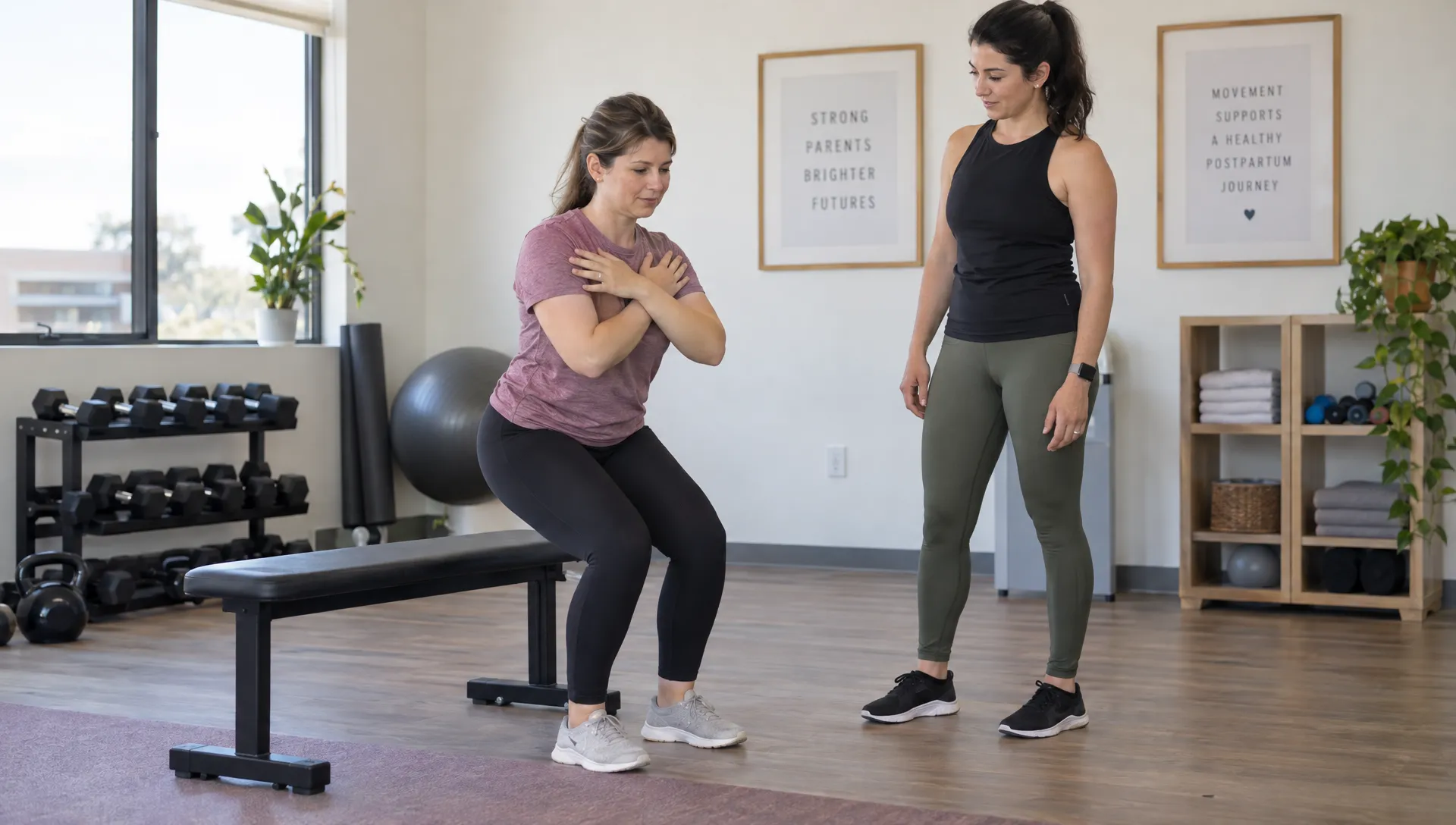
Movement observation should be gentle and relevant to your goals. It might include comfortable breathing, getting up from a chair or a supported squat. It should not involve diagnosing pelvic floor dysfunction or assessing a surgical wound, which falls outside a personal trainer’s scope.
Know which symptoms require a different response
A postpartum trainer should distinguish between normal exercise effort, symptoms that call for modification and signs that require medical attention. Pain or leakage should not be treated as evidence that you simply need to push harder.
Stop or modify the activity and seek appropriate assessment if you develop pelvic heaviness, urinary or bowel leakage, worsening pelvic or incision pain or symptoms that persist after the session. A pelvic health physical therapist can assess issues that exercise coaching alone cannot resolve.
Increased or renewed bleeding after activity deserves a conversation with your maternity care clinician, especially if it is heavier or accompanied by other symptoms.
Seek urgent medical care for chest pain, shortness of breath at rest, fainting, a severe or persistent headache, vision changes or one-sided calf swelling or pain. Heavy bleeding, particularly with dizziness, also needs urgent evaluation. These are not problems to troubleshoot in the gym.
A useful coach asks how you feel later that day and the following morning. A movement that feels fine during a short session may still be too demanding if symptoms increase afterward.
Rebuild coordination before chasing intensity
Early sessions often focus on breathing, comfortable movement and manageable strength work. This is not a requirement to remain at beginner level indefinitely. It is a way to establish what your body currently tolerates.
A postpartum trainer may use a comfortable exhale during an effort, such as standing from a chair, to help you coordinate the movement without excessive straining. Breathing cues should support the task, not become a rigid rule you must follow perfectly.
Pelvic floor work also needs individualization. Some people need help generating a contraction, while others need to improve relaxation or address pain. Repeated Kegels are not a universal solution.
A Cochrane review of pelvic floor muscle training during pregnancy and after childbirth found that effectiveness varies with the population, timing and purpose of training. Evidence supporting prevention in some pregnancy-related settings does not establish that one routine will treat every postpartum symptom.
Abdominal doming during an exercise can be a reason to adjust the movement or seek assessment, but it is not, by itself, proof of injury. Your trainer can reduce the demand, change your position or choose another exercise while a qualified clinician evaluates persistent concerns.
Build strength around everyday tasks
Strength work becomes especially useful when it makes daily life more manageable. Getting up from the floor, carrying a car seat and lifting a baby from a crib involve different positions and demands.
Your postpartum trainer can select exercises that develop those capacities without assuming that every familiar gym movement belongs in your first session. Supported squats, gentle rows or light carries may be appropriate for some people once medically suitable. Others need simpler options or additional rehabilitation first.
The following framework describes possible stages, not a fixed schedule or a workout prescription:
| Training emphasis | Possible activities when appropriate | What supports progression |
|---|---|---|
| Comfortable movement | Short easy walks, relaxed breathing, supported sit-to-stand | Activity remains comfortable without increased symptoms afterward |
| Foundational strength | Light rows, supported squats, simple hip-hinge practice | Movements are controlled and current demands feel manageable |
| Greater capacity | Gradually longer walks or modest increases in resistance | Recovery remains manageable and symptoms do not increase |
| Impact preparation | Individualized drills before running or jumping | Relevant restrictions are resolved and task-specific readiness is assessed |
Progress by changing one main variable at a time, such as resistance, repetitions or walking duration. Increasing several variables together makes it harder to identify what caused a symptom flare.
Treat running and jumping as separate milestones
Walking comfortably does not automatically establish readiness for running. Impact adds repeated loading that your current strength routine may not yet prepare you to tolerate.
A postpartum trainer should not base a return to running solely on the number of weeks since delivery. Relevant considerations include medical restrictions, pelvic health symptoms, walking tolerance, strength and your response to progressively more demanding tasks. Pelvic health physical therapy can be particularly helpful when symptoms are present or readiness is uncertain.
When running becomes appropriate, a gradual walk-run approach may be more manageable than immediately resuming your previous distance. Leave room to observe how you feel during the session and afterward before adding more.
Your former pace is not the most useful early benchmark. More informative questions are whether you can complete the planned activity comfortably, recover adequately and repeat it without increasing symptoms. Returning to impact may take longer than returning to other forms of exercise, and that difference does not mean your training has failed.
Check qualifications, referral habits and the training environment
The label “postpartum trainer” does not, by itself, establish a specific qualification or clinical license. Look for a recognized personal training credential, relevant postpartum continuing education and clear boundaries around what the coach can assess or treat.
Ask how they respond to pelvic pressure, leakage, incision discomfort or a difficult recovery. A thoughtful answer should include modifying activity and referring when appropriate, not promising to fix every issue through exercise.
Custom Fit’s guide to questions to ask during a personal training consultation can help you discuss assessment, communication and progress tracking. Add questions about postpartum experience and coordination with your maternity care clinician or pelvic health physical therapist.
The physical setup matters too. A training session should provide stable supports, appropriately adjusted machines and clear space to move, rather than improvised setups.
A coach should be comfortable explaining why an exercise was chosen and offering an alternative when it does not feel right.
Make the plan work with sleep, feeding and daily activity
A program can be physiologically reasonable yet impractical for your current life. Short sessions with flexible expectations often make more sense than a schedule that assumes uninterrupted sleep and reliable childcare.
Your postpartum trainer should adjust the day’s workload when fatigue is unusually high. That might mean less resistance, fewer exercises or an easy walk instead of a demanding session. The adjustment should preserve useful activity without treating exhaustion as a motivation problem.
If you are breastfeeding, moderate exercise is generally compatible with feeding. Feeding or pumping before a session may improve comfort, and a supportive bra can help. Bring questions about pain, supply concerns or other feeding issues to the appropriate clinician or lactation professional.
Adequate food and fluids also support the demands of recovery and training. Aggressive dietary restriction can make an already tiring period harder to manage. A registered dietitian can help you plan practical meals and discuss nutrition needs without making rapid weight change the organizing goal.
In San Francisco, daily terrain matters as well. For a parent taking stroller walks through Pacific Heights, hills may already represent a substantial workload. Count those walks when planning additional cardio rather than treating them as activity that does not count.
Track function instead of testing your limits
Early progress is often easiest to recognize in ordinary tasks: getting up from a chair more comfortably, walking farther without symptoms or feeling less fatigued after lifting your baby.
A postpartum trainer can help you track a few relevant measures, such as exercise tolerance, symptom response and how consistently you can complete manageable sessions. Keep the tracking simple enough that it does not become another demanding task.
Previous fitness experience is useful context, but your old training numbers are not a deadline. Custom Fit’s guidance on rebuilding fitness after a long break explains gradual progression more broadly. Postpartum recovery adds medical and pelvic health considerations that require their own attention.
Frequently asked questions
When can I start working with a trainer after giving birth? You can discuss goals and planning before resuming exercise. Active training should follow your clinician’s guidance and account for delivery type, complications, symptoms and current tolerance.
Do I need pelvic health physical therapy as well as a postpartum trainer? They serve different roles. Physical therapy provides clinical assessment and treatment, while a trainer supports exercise programming. Leakage, pelvic heaviness, persistent pain or difficulty progressing are reasons to seek assessment.
Can I strength train after a cesarean birth? Strength training can become part of recovery, but timing and loading depend on healing, symptoms and medical instructions. Do not progress through incision pain or disregard postoperative restrictions.
Should I stop exercising if I leak urine? Stop or modify the triggering activity and seek pelvic health assessment. You may still tolerate other activities, but recurring leakage should not be normalized as something you must accept or train through.
Discuss your return-to-exercise goals with Custom Fit
Custom Fit offers personal training and nutrition coaching with registered dietitians. When exploring Custom Fit’s San Francisco training options, ask about working with a postpartum trainer whose education, experience and referral approach match your recovery needs.
Bring any medical restrictions and explain which daily activities or workouts you want to regain. A suitable plan should start from your current capacity, make room for recovery and establish clear reasons to progress, modify or seek clinical input.