Why a Personal Trainer for Strength Training Works Faster


Most people do not need a harder workout. They need a better system.
That is why a personal trainer for strength training often works faster than trying to figure it out alone. The speed does not come from secret exercises or punishing sessions. It comes from removing guesswork, selecting the right training dose, improving technique, and keeping you consistent long enough for your body to adapt.
For busy professionals in San Francisco, that matters. If your calendar is packed, your training cannot depend on random motivation, inconsistent programming, or workouts copied from social media. Strength is a skill and a physiological adaptation. A good coach helps you practice that skill with the right plan, at the right intensity, with the right recovery.
What faster actually means in strength training
Faster does not mean overnight muscle gain. It means you spend fewer weeks doing the wrong things.
Strength training results usually come from a few fundamentals: progressive overload, adequate weekly volume, good technique, sufficient protein, recovery, and consistency. The problem is that each of those fundamentals has to be adjusted to your body, your schedule, your training history, and your goal.
A personal trainer speeds the process by making better decisions earlier. Instead of guessing whether you should add weight, change exercises, reduce volume, improve mobility, or eat more protein, you have someone watching the signal and adjusting the plan.
Research supports the importance of structured progression. The American College of Sports Medicine’s position stand on progression models in resistance training highlights how training variables such as load, volume, exercise selection, rest periods, and frequency need to be manipulated over time. That is exactly where an experienced coach can save months of trial and error.
A trainer finds your starting point instead of guessing it
One of the biggest reasons people stall is that they begin in the wrong place. Some start too aggressively, get sore, miss workouts, and lose momentum. Others stay too conservative for months and never create enough stimulus to build strength.
A skilled trainer looks at more than what you can lift today. They consider movement quality, injury history, work stress, sleep, training age, body composition goals, and what you can realistically repeat every week. The first few sessions are not just workouts, they are information gathering.
At a data-driven studio, assessments can make that process even more precise. DEXA scans can help distinguish fat loss from lean mass changes, while VO2 max testing can help shape conditioning so it supports strength rather than competes with it. If you want a deeper look at this approach, Custom Fit’s guide to personal training in San Francisco built around your data explains why objective measurement can improve coaching decisions.
This matters because the fastest plan is not always the most intense plan. It is the plan that produces progress you can recover from and repeat.
Programming beats random workouts
Random workouts can make you tired. Programming makes you stronger.
A strength program should answer several questions: what lifts you are training, how often you are training them, how many hard sets you need, when to increase load, when to back off, and how to balance strength with mobility, cardio, and recovery. Without those answers, you may be working hard without building momentum.
Training volume is a good example. A major meta-analysis by Brad Schoenfeld and colleagues found a dose-response relationship between weekly resistance training volume and muscle growth, meaning higher weekly set volume was generally associated with greater hypertrophy up to a point. You can read the study on weekly resistance training volume and muscle mass. The key phrase is up to a point. More is not always better if it exceeds your recovery capacity.
A personal trainer can help you find the productive middle. That may mean pushing harder on lower-body strength, reducing junk volume for shoulders, adding a hinge pattern, or changing rep ranges to improve joint comfort while still progressing.
For many people, the result is faster because the plan stops changing every Monday. Your body gets repeated exposure to the movements that matter, and your coach makes small adjustments before small problems become plateaus.
Better technique creates a better training signal
Strength training is not just moving weight from point A to point B. Small differences in setup, tempo, range of motion, bracing, and joint position can change which muscles are doing the work and how much stress your joints receive.
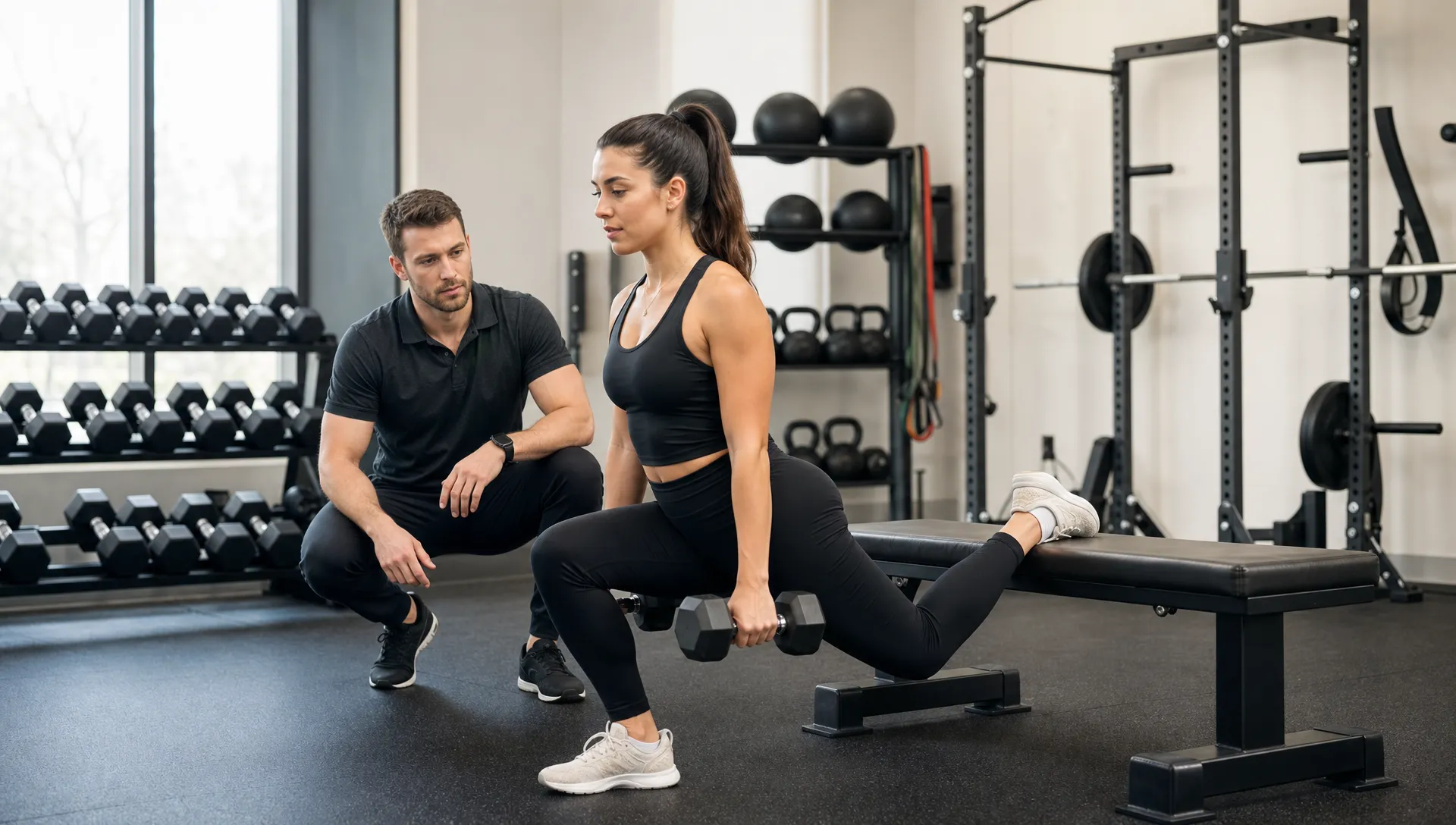
Take a squat. If your heels lift, your torso collapses, or your knees shift inconsistently, you may still complete the rep, but the training signal is less efficient. A trainer can cue the movement in real time, adjust stance, change the variation, or reduce load until the pattern improves.
The same applies to deadlifts, presses, rows, lunges, and core work. Good coaching helps you produce force safely and consistently. That means each set does more of what it is supposed to do.
This is one of the most underrated ways a personal trainer makes strength training faster. You are not just adding exercises. You are improving the quality of every rep.
Accountability is not a soft benefit
Accountability is often treated like a motivational extra, but it is one of the most practical reasons coaching works.
If you train alone, your workout is easy to move, shorten, or skip when work runs late. With a trainer, the appointment exists. The plan exists. Someone is expecting you to show up, and someone knows what you did last week.
Busy professionals already understand the value of specialists. You might rely on a concierge physician for preventive care, a registered dietitian for nutrition, or expert color and styling when presentation matters. Strength training is similar in one important way: when the outcome matters and your time is limited, expert guidance reduces waste.
The consistency piece is especially important because muscle and strength are built through repeated exposure. A great workout once a month will not outperform a good program performed three times a week. A trainer helps you protect that rhythm.
Nutrition and recovery make the workouts count
Strength is built between sessions as much as during them. Training provides the stimulus, but food, sleep, and recovery determine how well you adapt.
Protein intake is a clear example. A large systematic review and meta-analysis in the British Journal of Sports Medicine found that protein supplementation can enhance gains in muscle mass and strength during resistance training, especially when total protein intake is optimized. That does not mean everyone needs the same target or the same supplement. It means nutrition should match the training goal.
A good trainer will not treat nutrition as an afterthought. They may coordinate with a registered dietitian, help you understand meal timing, or identify patterns that are limiting progress, such as under-eating during a fat loss phase, inconsistent protein, or relying on caffeine instead of recovery.
Recovery also includes the way your program is organized. If every session is maximal, progress may stall because fatigue hides fitness. Strategic deloads, exercise rotation, mobility work, and recovery services can help you train hard without constantly feeling beat up.
Data helps you avoid chasing the wrong goal
A scale can tell you body weight. It cannot tell you whether you gained lean mass, lost fat, improved power, or built a more resilient cardiovascular base.
This is where testing can make strength training more efficient. DEXA scans can help track lean mass and body composition. VO2 max testing can show whether conditioning is supporting your health and performance. Strength assessments can show whether your program is improving the lifts or movement patterns that matter most to you.
For longevity clinics, concierge medicine practices, and employee wellness teams, this is also where personal training becomes more than a fitness perk. Testing identifies the baseline. Coaching turns that baseline into action. For clients, patients, or employees who need measurable progress, the combination of assessment and supervised training can create a clearer path from data to behavior change.
Muscle is not just cosmetic. A systematic review in the British Journal of Sports Medicine found that muscle-strengthening activities were associated with lower risk of all-cause mortality. For adults who care about healthspan, performance, and independence, strength training deserves the same seriousness as nutrition, sleep, and preventive care.
How to make personal training work faster for you
Hiring a trainer is not magic. The best results come when you treat the relationship as a partnership.
Before you start, clarify what faster means for you. Do you want to increase strength, add lean mass, reduce body fat, improve posture, prepare for a sport, protect long-term mobility, or feel better in daily life? The more specific the goal, the easier it is to design the right plan.
A few habits make coaching more effective:
- Show up consistently: Two to four well-planned sessions per week will usually beat sporadic intensity.
- Track what matters: Loads, reps, body composition, energy, sleep, and soreness all help guide the plan.
- Be honest about recovery: Work stress, alcohol, travel, and poor sleep affect performance.
- Follow the boring basics: Protein, hydration, walking, and bedtime consistency often amplify training results.
- Ask questions: Understanding why you are doing something improves buy-in and execution.
The goal is not to become dependent on a trainer forever. The goal is to build competence, confidence, and measurable progress faster than you would on your own.
What to look for in a personal trainer for strength training
Not every trainer is the right fit for strength work. Some are excellent motivators but weak programmers. Others know advanced methods but struggle to adapt training to a real person with a demanding life.
Look for a coach who can explain the plan clearly, assess your starting point, teach movement quality, adjust training based on results, and coordinate with nutrition or recovery professionals when needed. They should be able to progress you without making every session feel like a test of survival.
A strong personal training experience should include more than workouts. It should include goals, assessments, programming, coaching, progress tracking, and support outside the hour when appropriate. If you are comparing options, this breakdown of what should be included in a personal training package is a useful way to evaluate quality.
You should also ask how the trainer balances strength with cardio. Conditioning can support health and recovery, but poorly placed endurance work may interfere with strength goals for some people. Custom Fit’s article on how to balance strength training and cardio explains how to make both work together.
Frequently Asked Questions
Is a personal trainer worth it for strength training? A personal trainer is worth it if you want a structured plan, better technique, accountability, and faster problem solving. The value is highest when your time is limited, you are new to lifting, you have plateaued, or you want measurable progress.
How often should I train with a personal trainer to get stronger? Many people do well with two to three coached strength sessions per week, depending on goals, experience, and recovery. Some clients use one session weekly for programming and technique, then complete additional sessions independently.
Can a trainer help me build muscle and lose fat at the same time? Yes, especially if you are newer to strength training, returning after time off, or improving nutrition. A trainer can pair progressive resistance training with appropriate nutrition habits and body composition tracking.
How quickly will I see results from strength training? Many people notice improved confidence, coordination, and energy within a few weeks. Visible body composition changes and larger strength gains usually take longer, often several months of consistent training, nutrition, and recovery.
Do I need testing like DEXA or VO2 max to benefit from a trainer? No, but testing can make the process more precise. DEXA and VO2 max data can help clarify your baseline, track progress, and guide training decisions beyond what the scale or mirror can show.
Build strength with a smarter system
A personal trainer for strength training works faster because the process becomes clearer. You know what to do, how hard to do it, when to progress, and how to recover so the work actually pays off.
At Custom Fit, personal training, nutrition coaching, longevity testing, DEXA scans, VO2 max testing, recovery programs, memberships, and group classes are designed to support measurable progress. If you want strength training that fits your body, your goals, and your schedule, start with a plan built around better data and expert coaching.