What an Integrative Nutrition Health Coach Can and Cannot Do



If you are considering working with an integrative nutrition health coach, the most useful first question is not whether coaching is good or bad. It is whether the person you hire is operating within the right scope for your goal. A coach can be invaluable for habits, accountability, food environment and day-to-day decision-making. They are not a substitute for a physician, a registered dietitian or a licensed clinician when your needs become medical.
For busy San Francisco professionals, founders, physicians, longevity clinics and employee benefits teams, that distinction matters. Good nutrition support should make life simpler, not blur lines around diagnosis, treatment or clinical care.
Why scope matters before you hire support
Nutrition advice sits on a spectrum. On one end, you have general wellness guidance, meal structure, habit design and accountability. On the other, you have medical nutrition therapy, medication decisions, eating disorder treatment, lab diagnosis and disease management. Those categories require different training, credentials and legal permissions.
The National Board for Health and Wellness Coaching describes coaching as a client-centered process that supports self-directed goals, motivation and sustainable behavior change. That definition is useful because it places the coach in a collaborative role, not in the role of a clinician.
The right integrative nutrition health coach should welcome those boundaries because they protect your health and make the coaching more effective. Clear scope is normal in other complex fields too. A company might hire a freight-forwarding and warehousing team like SHIPIT Logistics for transportation, fulfillment and supply chain coordination, but it would not ask that same team for medical advice. Wellness support deserves the same clarity.
What an integrative nutrition health coach can do
Turn broad goals into repeatable behaviors
Most people do not fail because they lack information. They struggle because their work calendar, travel, family obligations, stress and sleep patterns make healthy choices inconsistent. A coach can help convert a vague goal, such as eat better or improve energy, into specific actions you can repeat on a Tuesday night after a long workday.
Health coaching has been studied as a behavior-change intervention across lifestyle and chronic disease settings. A systematic review by Wolever and colleagues in Global Advances in Health and Medicine found that health and wellness coaching was associated with improvements in several health behaviors and outcomes, though results depended on program quality and population (PubMed).
A well-trained integrative nutrition health coach can help with planning breakfasts, protein timing, grocery routines, restaurant strategies, hydration habits and travel defaults. The value is not a perfect plan. The value is a plan that survives real life.
Help you understand patterns without moralizing food
Coaching can identify patterns that are easy to miss when you are busy. Maybe late meetings lead to skipped lunch and 10 p.m. overeating. Maybe client dinners make weekday alcohol creep higher than intended. Maybe a high-stress quarter changes your appetite, sleep and recovery.
A coach can help you test small adjustments, such as shifting protein earlier in the day, preparing two default lunches or changing your pre-commute snack. This work is practical and behavioral. It should not turn food into a source of guilt or create rigid rules that ignore culture, enjoyment and social life.
Coordinate with the rest of your wellness team
A coach can also help translate recommendations from a registered dietitian, personal trainer or physician into daily execution. For example, if a clinician recommends a higher-fiber diet or a trainer adjusts your strength program, the coach can help build the routines that make those changes happen.
This is where integrated wellness can be powerful. When nutrition, training and recovery are aligned, clients are less likely to receive conflicting advice. Custom Fit has written more about why a registered dietitian and personal trainer make a stronger team, especially for clients pursuing strength, fat loss, longevity or performance goals.
What an integrative nutrition health coach cannot do
Diagnose, treat or manage medical conditions
A health coach should not diagnose diabetes, thyroid disease, gastrointestinal disorders, kidney disease, cardiovascular disease, nutrient deficiencies or hormonal conditions. They should not interpret abnormal labs as a diagnosis or tell you to start, stop or change medication.
When a diagnosis, medication or lab abnormality is involved, an integrative nutrition health coach should help you prepare better questions for the licensed clinician rather than acting as the clinician. If a coach presents supplements, fasting protocols or elimination diets as treatment for a medical condition, that is a red flag.
Provide medical nutrition therapy unless licensed to do so
Registered dietitians are trained to provide medical nutrition therapy, which can include nutrition care for diabetes, cardiovascular disease, kidney disease, digestive disorders, pregnancy, eating disorders and other clinical needs. Some health coaches are also registered dietitians. Many are not.
That distinction matters. A coach may be able to support general wellness behaviors, but a registered dietitian is the better fit when nutrition guidance must account for disease, medication, lab values, clinical risk or specialized nutrition needs.
| Need or situation | Best lead professional | Why it matters |
|---|---|---|
| Building consistent meals, grocery routines and accountability | Health coach or nutrition coach | The focus is behavior change and follow-through |
| Diabetes, kidney disease, eating disorder history or complex GI symptoms | Registered dietitian and physician | These needs require clinical assessment and medical nutrition therapy |
| Medication changes, diagnosis or lab interpretation | Physician, nurse practitioner or physician assistant | These decisions sit within licensed medical care |
| Strength gain, body recomposition and training progression | Personal trainer, registered dietitian and exercise physiologist | Food, training and recovery need to match the goal |
Promise results they cannot control
No coach should guarantee a specific amount of fat loss, muscle gain, lab improvement or longevity outcome. Human physiology is variable. Sleep, stress, medications, hormones, training history, injury status and genetics all affect results.
The best coaches set up a process, measure what is appropriate and adjust when the data changes. They do not sell certainty where none exists.
How integrative coaching fits with data-driven testing
DEXA, VO2 max and body composition
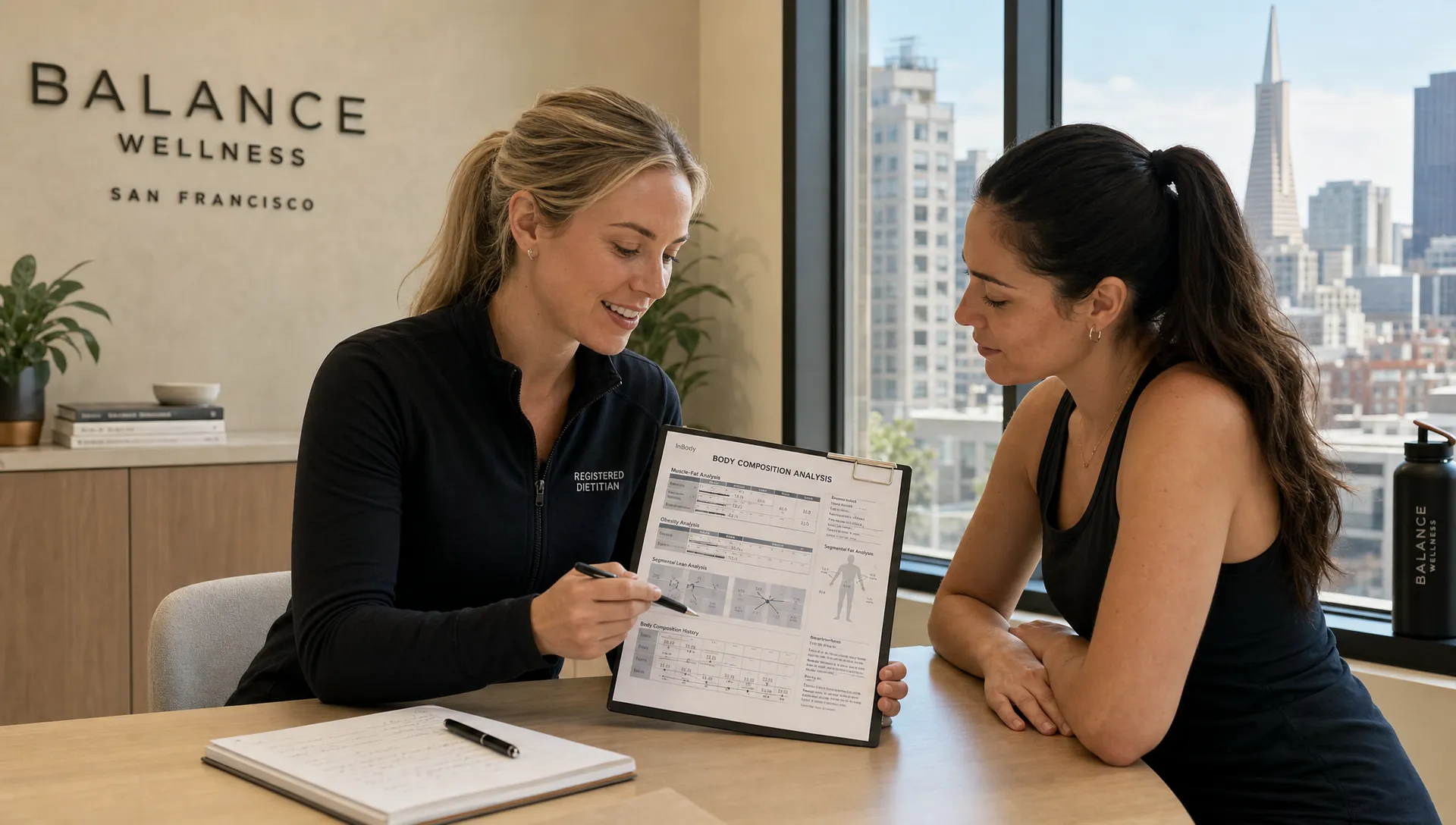
Data can make nutrition coaching more precise, but only when the data is interpreted correctly. Body weight alone cannot tell you whether you are gaining muscle, losing fat, preserving bone or reducing visceral fat. That is why tools such as DEXA scans, VO2 max testing and metabolic assessments can be useful in a structured wellness program.
At Custom Fit, DEXA scans are performed by Registered Dietitians or Exercise Physiologists. That matters because clients are working with professionals who understand nutrition, exercise physiology and body composition, not simply receiving an automated scan report. A DEXA scan can provide information on body fat, lean mass, bone density and visceral fat, but the next step should be a thoughtful conversation about what the numbers mean for your training, nutrition and recovery.
The CDC’s NHANES program uses DXA technology to assess body composition in population health research, which reflects its value as a measurement tool when protocols are properly managed (CDC NHANES DXA). For aerobic fitness, the American Heart Association scientific statement argues that cardiorespiratory fitness is a powerful health marker that deserves more attention in clinical and wellness settings.
An integrative nutrition health coach can help you turn those results into repeatable habits, but the results themselves need interpretation by qualified professionals.
Avoiding data without action
Testing can become expensive trivia if no one connects it to behavior. If a DEXA scan shows low lean mass, your plan may need enough protein, progressive strength training, recovery and time. If visceral fat is elevated, the plan may need a mix of nutrition quality, sleep consistency, alcohol awareness, aerobic fitness and medical follow-up when appropriate.
A coach can support the weekly execution, but the interpretation should match the professional’s training. That is the difference between data-driven wellness and simply collecting reports.
When you need a higher level of care
Situations that call for clinical support first
If your goal is general wellness, consistency or performance support, coaching may be a good starting point. If your goal involves symptoms, diagnoses or medical risk, start with a licensed clinician.
If those issues apply, the safest integrative nutrition health coach is one who refers out early and collaborates rather than trying to manage everything alone.
| Your situation | Better first step |
|---|---|
| You have diabetes, kidney disease, heart disease or active GI symptoms | Physician and registered dietitian |
| You are taking GLP-1 medication or another appetite-altering drug | Prescribing clinician and registered dietitian |
| You have a history of disordered eating | Physician, therapist and eating disorder-trained dietitian |
| You are pregnant, postpartum or managing fertility concerns | OB-GYN and registered dietitian |
| You want to gain muscle while losing fat | Integrated team with nutrition, training and body composition testing |
Why this distinction helps clients get better results
Scope boundaries do not make coaching less valuable. They make it safer and more useful. When a coach knows when to refer, the client gets the right help sooner. When an RD or physician has a coach supporting daily implementation, clinical recommendations are more likely to become habits.
This is especially relevant for high-performing professionals who already outsource legal, financial and operational expertise. Health decisions deserve the same level of role clarity.
How to evaluate fit in San Francisco
Questions to ask before you begin
A good integrative nutrition health coach will answer scope questions directly. If the conversation feels vague, sales-heavy or anti-medical, keep looking.
Ask these questions before committing:
- What credentials, training and supervision do you have?
- What is outside your scope, and when do you refer to a registered dietitian or physician?
- How do you personalize recommendations around travel, restaurants, work stress and training?
- How will progress be measured beyond scale weight?
- Do you coordinate with trainers, dietitians, physicians or longevity clinics when needed?
If your schedule moves from SoMa meetings to dinner in Pacific Heights, practical fit matters as much as nutrition philosophy. A plan that ignores commute time, client meals and late work nights will not last. For a deeper local hiring framework, use this guide to choosing a nutrition coach in San Francisco.
Signs of a strong professional
The best coaches are specific, collaborative and evidence-informed. They ask about sleep, stress, training, medical history and food access before giving advice. They do not shame you for eating out or imply that one supplement protocol will solve everything.
They should also be comfortable saying: that is a question for your physician, or that is something a registered dietitian should guide. Those sentences are signs of professionalism, not weakness.
The best use case: coaching plus qualified clinical support
For many clients, the best answer is not coach versus clinician. It is using each professional for the work they are trained to do. An integrative nutrition health coach can be valuable for behavior change, meal routines and accountability, while a registered dietitian, exercise physiologist, personal trainer or physician handles clinical interpretation, training design and medical decision-making.
For employee benefits managers, concierge medicine practices and longevity clinics, this team-based approach is often the safest model. It gives people enough support to change their daily behavior without pretending that every wellness provider is interchangeable.
For individuals, it also reduces wasted effort. If your DEXA scan, VO2 max test, nutrition plan and training program all point in the same direction, you are less likely to chase conflicting advice.
Frequently Asked Questions
Is an integrative nutrition health coach the same as a registered dietitian? No. A coach usually focuses on habits, accountability and lifestyle support. A registered dietitian can provide medical nutrition therapy for clinical conditions. Some coaches are also dietitians, but you should verify credentials rather than assume.
Can a health coach write me a meal plan? A coach may help you build meal structure, routines and general food strategies. If the meal plan is intended to treat a disease, manage medication-related nutrition needs or address a clinical condition, a registered dietitian is usually the more appropriate professional.
Should I work with a coach if I already have a doctor? Yes, if the coach stays within scope and supports implementation. A physician may identify what needs to change, while a coach helps you practice those changes between appointments.
How does body composition testing change nutrition coaching? Testing can show whether changes in weight reflect fat loss, muscle gain, lean mass loss or shifts in visceral fat. At Custom Fit, DEXA scans are performed by Registered Dietitians or Exercise Physiologists, so clients receive context from professionals who understand nutrition, exercise physiology and body composition.
What is the biggest red flag when hiring a coach? Be cautious if a coach discourages medical care, promises guaranteed outcomes, diagnoses conditions, sells supplements as treatment or cannot explain when they would refer you to a licensed professional.
If you want nutrition support that respects scope, data and real life, Custom Fit’s San Francisco studio brings personal training, nutrition coaching, DEXA scans, VO2 max testing and recovery services into one coordinated environment. Whether you are commuting from SoMa, Pacific Heights or another part of the city, the goal is not more wellness noise. It is clearer guidance from professionals who know where coaching ends and clinical care begins.