How to Recover Fitness After a Long Break From Exercise


A long break from exercise can feel like starting over, but it usually is not. Your cardiovascular fitness, strength, coordination and confidence may have dipped, yet your body still has a training history. The goal is not to punish yourself for time away. The goal is to recover fitness with a plan that respects your current baseline and rebuilds momentum safely.
For most people, the biggest mistake is trying to resume the exact workouts they did before the break. That often leads to excessive soreness, joint irritation or a cycle of two hard workouts followed by another week off. A smarter return uses measured progression: assess where you are now, rebuild consistency first, layer in strength and aerobic work, then increase intensity only after your body is adapting well.
What happens to fitness during a long break?
Detraining is real, but it is not permanent. In a review published in Sports Medicine, researchers Iñigo Mujika and Sabino Padilla described how endurance, metabolic adaptations and performance can decline when training stops or drops sharply, especially after complete inactivity. You can read the PubMed summary of their work on loss of training adaptations during detraining.
Cardio tends to feel different first. After weeks or months away, a pace that used to feel easy may push your heart rate higher than expected. Strength often returns more quickly than conditioning, especially if you trained consistently in the past, but tendons, ligaments and connective tissue still need a slower ramp. That is why someone may be able to lift a challenging weight on day one, then feel sore or achy for several days afterward.
There is also a skill component. Squats, hinges, presses, running mechanics and breathing rhythm all become less efficient when they have not been practiced. The first few weeks are partly about reminding your nervous system how to move well, not proving how hard you can work.
Start with a baseline, not a guess
Before you try to recover fitness after a long break from exercise, get honest about your starting point. A baseline does not need to be complicated, but it should give you enough information to make your first month realistic.
If you have chest pain, unexplained shortness of breath, dizziness, a recent surgery, a major injury or a known heart or metabolic condition, talk with your physician before restarting. This is especially relevant for people who have been inactive for a year or more or who plan to jump into vigorous training.
For everyone else, useful baseline markers include resting heart rate, blood pressure, walking tolerance, basic movement quality, previous injury history, current sleep and current weekly schedule. If body composition has changed during the break, testing can also help separate what you think changed from what actually changed.
At Custom Fit, DEXA scans are performed by Registered Dietitians or Exercise Physiologists. That matters because clients are working with professionals who understand nutrition, exercise physiology and body composition, not simply receiving an automated scan report. A DEXA scan can help track body fat, lean mass and visceral fat estimates over time, while VO2 max testing can establish an objective cardiorespiratory baseline.
| Baseline check | What it helps you understand | How to use it |
|---|---|---|
| Resting heart rate and blood pressure | General readiness and cardiovascular strain | Track trends, not single readings |
| Movement screen | Mobility, control and pain points | Choose exercises that fit your body now |
| DEXA body composition | Lean mass, fat mass and visceral fat estimates | Set more precise goals than scale weight alone |
| VO2 max or submax cardio test | Current aerobic capacity | Set training zones and avoid guessing intensity |
| Weekly schedule | Realistic workout frequency | Build a plan you can repeat during busy weeks |
For San Francisco professionals commuting between neighborhoods like SoMa and the Financial District, schedule friction is often the hidden barrier. A realistic plan that fits around meetings, travel and family obligations will beat an ideal plan that only works on your calmest week.
Use the first two weeks as an on-ramp
The first two weeks should feel almost too easy. That is not wasted time. It is how you rebuild consistency, reduce soreness and give your joints a chance to tolerate training again.
A good target is two to three strength sessions per week plus two to four low intensity cardio sessions. Strength sessions can be 35 to 50 minutes. Cardio can be as simple as brisk walking, cycling, incline treadmill walking or easy rowing for 20 to 40 minutes. Keep most work at a conversational pace.
Use rate of perceived exertion, or RPE, as a simple guardrail. On a scale of 1 to 10, with 10 being maximal effort, your first two weeks should mostly live around 5 to 6. You should finish workouts feeling like you could have done more. If you are sore for more than two days after every session, reduce volume before you reduce consistency.
Environment matters. Keep shoes, workout clothes and a water bottle ready so preparing for a session takes less effort.
If you want a broader habit framework, Custom Fit has a helpful guide to fitness training habits that deliver better long-term results, including consistency, progression and planning around real life.
Rebuild strength before chasing intensity
Strength training is one of the best anchors for returning to fitness because it supports muscle mass, joint function, glucose control and everyday resilience. After a break, the best approach is full-body training with simple movement patterns.
Focus on squatting, hinging, pushing, pulling, carrying and core control. You do not need exotic exercises in month one. You need clean reps, manageable loads and repeatable sessions.
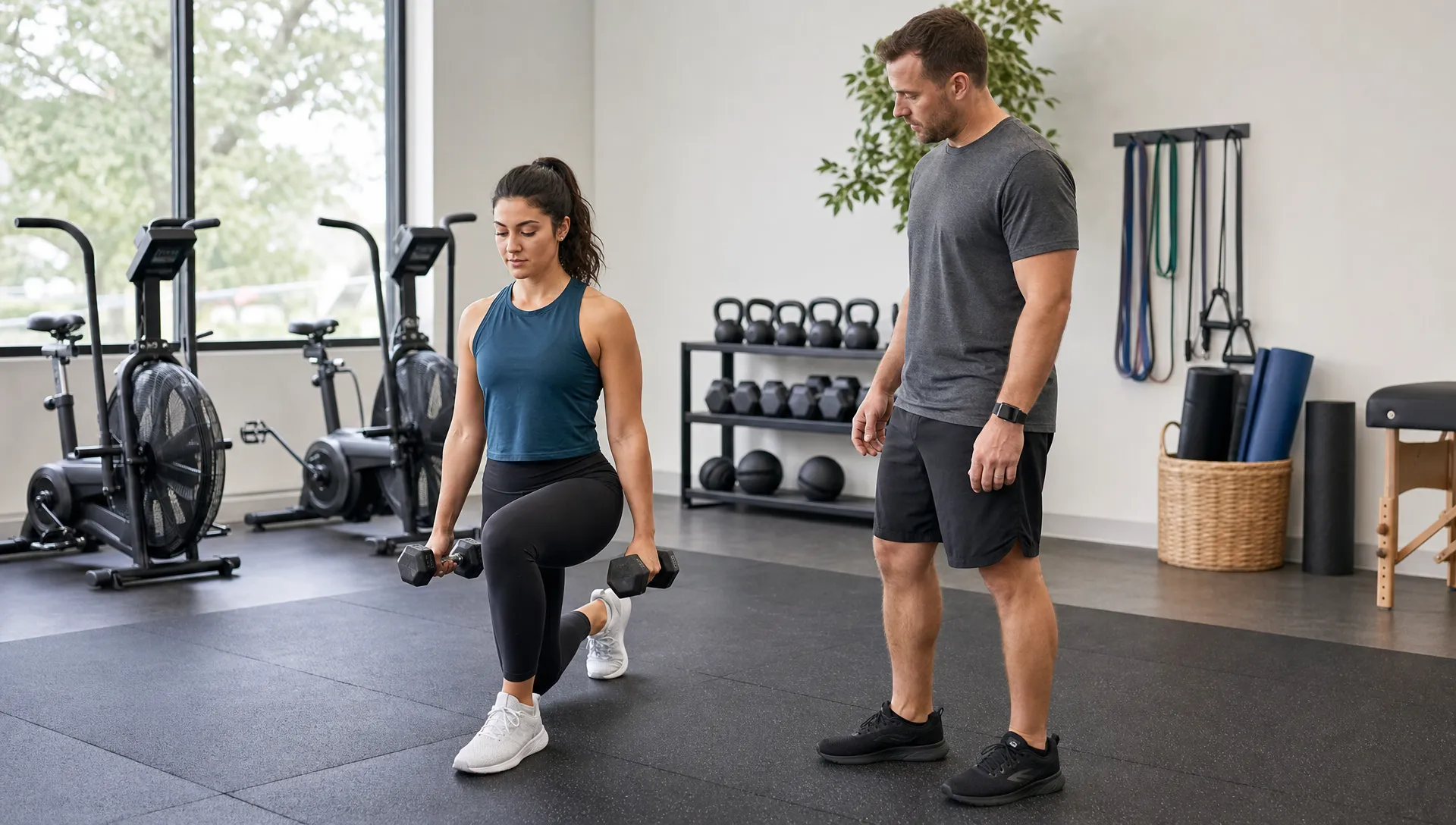
A practical first phase might include goblet squats, Romanian deadlifts, step-ups, cable rows, incline push-ups, dumbbell presses, farmer carries and dead bugs. Choose loads that allow you to stop with two to four reps in reserve. That buffer reduces injury risk and gives you room to progress.
| Return phase | Strength focus | Cardio focus | Intensity target |
|---|---|---|---|
| Weeks 1 to 2 | Learn movements, light to moderate loads, 2 sets per exercise | Easy walks or bikes, 20 to 40 minutes | Mostly RPE 5 to 6 |
| Weeks 3 to 6 | Add sets or small load increases, 2 to 3 full-body sessions | Build total weekly time gradually | Mostly RPE 6 to 7 |
| Weeks 7 to 12 | Progress heavier lifts, add power or intervals if appropriate | Add structured tempo or interval work | Some RPE 8 work, not every session |
Do not increase everything at once. If you add weight this week, keep sets stable. If you add another training day, keep intensity moderate. If you add intervals, do not also increase lower body lifting volume aggressively. One meaningful progression at a time is enough.
Rebuild cardio without turning every session into a test
Cardio often feels humbling after time away, so many people avoid it or overdo it. Neither helps. The fastest sustainable way back is to rebuild your aerobic base first.
The Physical Activity Guidelines for Americans recommend adults get 150 to 300 minutes of moderate intensity aerobic activity per week, plus muscle-strengthening activity on two or more days. If you are returning from a long break, you do not need to hit the full guideline in week one. Use it as a destination.
Start with low intensity aerobic work that lets you speak in full sentences. This builds tolerance without draining your recovery. Once you can complete two to three weekly sessions comfortably, add one moderate session with short pickups, hills or intervals. For example, after a warm-up, alternate one minute slightly harder with two minutes easy for 6 to 10 rounds.
If longevity or performance is a major goal, objective testing can help. VO2 max testing gives you more precise zones than smartwatch estimates alone and can show whether your training is improving the capacity that matters for health and performance. For a deeper look at the training categories that support health span, see Custom Fit’s guide to the essential workouts for longevity and everyday strength.
Make recovery part of the program
When you are trying to recover fitness, recovery is not what happens after the plan. It is part of the plan. Training creates the signal. Recovery determines how well your body adapts to that signal.
Sleep is the first lever. If your workweek regularly cuts sleep short, your training plan should account for that. A high-stress week may call for technique work, easy cardio and mobility instead of heavy lifts and intervals. This is not lowering standards. It is matching training stress to total life stress.
Nutrition is the second lever. After a long exercise break, many people either under-eat because they want quick fat loss or over-rely on high intensity workouts without enough protein and carbohydrates to support adaptation. A better approach is to eat enough protein across the day, include carbohydrates around harder sessions and avoid aggressive calorie restriction during the first few weeks back.
A systematic review and meta-analysis led by Robert Morton and colleagues found that protein supplementation can improve gains in strength and fat-free mass during resistance training, with benefits generally plateauing around 1.6 grams of protein per kilogram of body weight per day for many adults. The PubMed record is available here: protein supplementation and resistance training adaptations.
Post-workout nutrition does not need to be complicated. A meal with protein, carbohydrates, fluids and micronutrient-rich foods is enough for most people. If you train early before work or squeeze sessions between meetings, planning this meal in advance prevents the common pattern of finishing a workout, rushing into calls and under-fueling until late afternoon. Custom Fit covers this in more detail in its article on why post-workout nutrition matters for recovery.
A simple first month plan
This sample assumes you are generally healthy, returning after at least a few months away and not training for a specific competition. Adjust downward if you have pain, poor sleep or a very high-stress schedule.
| Week | Strength | Cardio | Recovery priority |
|---|---|---|---|
| 1 | 2 full-body sessions, light loads | 2 easy sessions, 20 to 30 minutes | Finish workouts with energy left |
| 2 | 2 to 3 full-body sessions | 2 to 3 easy sessions, 25 to 35 minutes | Reduce soreness before adding volume |
| 3 | 3 full-body sessions, small load increases | 3 sessions, one with short moderate pickups | Keep one full rest day |
| 4 | 3 sessions, add one set to key lifts if tolerated | 3 to 4 sessions, mostly easy | Review energy, sleep and joint feedback |
The plan should feel repeatable. If you need more than two days to recover from each workout, the plan is too aggressive. If every session feels effortless and you are sleeping well, add a small progression the next week.
Signs you are doing too much
Some discomfort is normal when you return to exercise. Sharp pain, worsening joint irritation and persistent fatigue are not. The point is to create a training rhythm you can sustain for months, not survive a heroic first week.
| Sign | What it may mean | What to change |
|---|---|---|
| Soreness lasting more than 72 hours | Volume or novelty is too high | Reduce sets, slow progression or repeat the week |
| Joint pain that worsens during warm-up | Exercise selection may not fit | Modify range of motion or swap the movement |
| Resting heart rate unusually elevated | Recovery may be lagging | Add sleep, hydration or an easier training day |
| Motivation crashes after hard sessions | Intensity is too frequent | Keep most workouts moderate |
| Performance drops for multiple workouts | Total stress exceeds recovery | Take a deload week or reduce training load |
The opposite problem is also common. If you train once every 10 days, never progress exercises and avoid any mild challenge, your body will not receive enough stimulus to adapt. Fitness returns when the workload is consistent, recoverable and gradually progressive.
When professional guidance helps
A coach, Registered Dietitian or Exercise Physiologist can shorten the trial-and-error period. Professional guidance is especially valuable if you have a history of injuries, significant body composition changes, a demanding executive schedule, peri-menopause or menopause-related changes, metabolic health goals or a specific performance target.
This is where data-driven training is useful. At Custom Fit in San Francisco, clients can combine personal training, nutrition coaching, recovery support, DEXA body composition testing and VO2 max testing in one setting. For DEXA in particular, scans are performed by Registered Dietitians or Exercise Physiologists, so your results can be interpreted in the context of nutrition, training history and physiology rather than treated as a stand-alone report.
If you live or work near SoMa, the Embarcadero or the Financial District, a nearby studio can also reduce commute friction. That matters more than most people admit. The best recovery plan is the one you can actually follow during a full calendar week.
Frequently Asked Questions
How long does it take to recover fitness after a long break? Many people feel noticeably better within 2 to 4 weeks, but rebuilding strength, aerobic capacity and body composition often takes 8 to 12 weeks or more. Your timeline depends on training history, break length, sleep, nutrition, stress and consistency.
Should I start with cardio or weights? Most people should restart both, but keep them moderate. Strength training helps rebuild muscle and joint capacity, while easy cardio restores aerobic fitness. Avoid making high intensity cardio the foundation during the first couple of weeks.
How sore should I be after returning to exercise? Mild soreness is normal. Severe soreness, soreness that lasts more than 72 hours or pain that changes how you move means the workout was probably too much. Reduce volume, load or exercise novelty.
Can I lose fat and regain muscle at the same time? Yes, especially if you are returning after a break and follow a consistent strength plan with enough protein. DEXA testing can help distinguish fat loss, muscle gain and scale fluctuations more clearly than body weight alone.
Do I need VO2 max or DEXA testing before I restart? Not everyone needs testing, but it can be useful if you want objective baselines, have performance goals or want a clearer picture of body composition. Testing is most valuable when a qualified professional helps translate the results into a realistic plan.
Restart with a plan you can sustain
The best way to recover fitness after a long break from exercise is to rebuild trust with your body. Start below your ego, train consistently, progress gradually and support the work with sleep, nutrition and recovery.
If you want a structured restart with expert coaching and objective testing, Custom Fit can help you build a plan around your current fitness, schedule and goals. A data-driven baseline can make the path back clearer, safer and easier to sustain.