How Personal Training Programs Should Evolve With Your Data



A strong training plan should not look the same on day 90 as it did on day one. If your strength, body composition, cardiovascular fitness, recovery, schedule, stress, and nutrition habits are changing, your program should change too.
That is the real promise of data-informed coaching. Not more numbers for their own sake, but better decisions. The most effective personal training programs turn measurements into a practical feedback loop: assess, train, observe, adjust, and reassess.
For busy professionals in San Francisco, this matters because time is the constraint. You do not need random workouts, another app dashboard, or a trainer who simply counts reps. You need a program that knows when to push, when to deload, when nutrition is the limiting factor, and when a new baseline test is the smartest next step.
Why static personal training programs fall short
Traditional personal training often starts with a goal, then moves quickly into workouts. That can be useful in the beginning, especially for building consistency. But if the plan never evolves, it eventually becomes a guess.
Your body adapts. A weight that was challenging six weeks ago may no longer create enough stimulus. A calorie target that worked during a lower-stress period may become unrealistic during travel or a demanding work cycle. A conditioning plan that improved your endurance at first may need more precision once progress slows.
Research supports the idea that exercise programming should progress over time. The American College of Sports Medicine’s position stand on progression models in resistance training emphasizes variables such as load, volume, frequency, rest periods, and exercise selection. In other words, results come from manipulating the right levers at the right time, not repeating the same session indefinitely.
The same principle applies in business. High-performing founders do not run revenue from vibes alone. They use dashboards, diagnostics, and decision rules, like the approach described in this revenue acceleration methodology for founder-led B2B businesses. Fitness should operate with the same discipline: measure what matters, interpret it correctly, then act.
Start with baseline data, not assumptions
The first evolution in modern coaching is the move away from generic onboarding. A good program should not begin with “What workout do you like?” It should begin with “What is true right now?”
Useful baseline data may include your current training history, injury background, movement quality, strength levels, body composition, cardiovascular fitness, nutrition patterns, sleep, stress, schedule, and goal timeline. For some people, a simple movement and strength assessment may be enough to start. For others, more advanced testing can provide a clearer picture.
At Custom Fit, available services include personal training, nutrition coaching, DEXA scans, VO2 max testing, longevity testing, recovery programs, and registered dietitian support. That does not mean every person needs every test. It means your coaching team can choose more precise inputs when they are relevant.
If you want a deeper look at the foundations of a comprehensive coaching relationship, this guide on what should be included in a personal training package explains why assessments, progression, and support matter beyond the workout itself.
The data that should change your training plan
Not every metric deserves equal attention. The best personal training programs distinguish between interesting data and decision-making data.
A wearable score might be interesting. A repeated drop in performance, poor sleep, elevated perceived fatigue, and stalled progress together are decision-making data. A single body weight reading might be noise. A trend across several weeks, combined with DEXA results and nutrition adherence, can be useful.
Here are the categories that should most often influence how your plan evolves.
Strength and performance trends
Strength data shows whether your program is creating adaptation. Your coach should be looking at more than one-rep max numbers. Progress can show up through better technique, more reps at the same load, improved bar speed, more stable positions, better control, or less fatigue at a given workload.
If strength is climbing and recovery is strong, the plan may progress through higher loads, added volume, or more advanced exercise variations. If strength is flat, your coach may adjust exercise selection, reduce unnecessary fatigue, improve recovery, or revisit nutrition.
This is where coaching judgment matters. A plateau does not always mean you need to work harder. Sometimes it means the program is too intense, too monotonous, or poorly matched to your current life demands.
Body composition and metabolic context
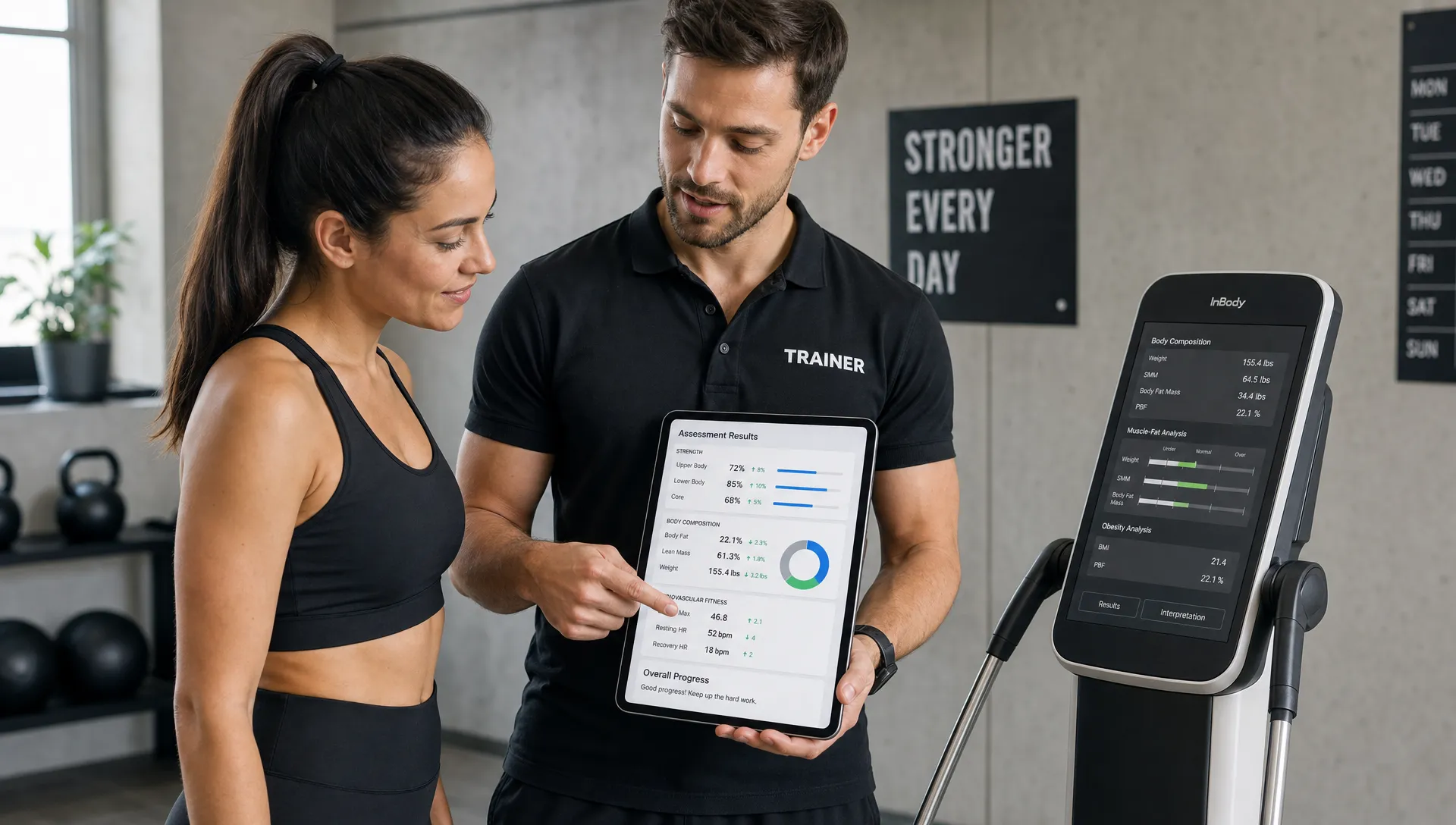
Scale weight alone is a blunt tool. It can miss meaningful changes in lean mass, fat mass, and regional distribution. DEXA scans can provide a more detailed view of body composition, which may help guide fat loss, muscle gain, and longevity-focused goals.
For example, two clients may both lose five pounds. One may lose mostly fat while preserving lean tissue. Another may lose weight too quickly and sacrifice muscle. Those are very different outcomes, and they should lead to different coaching decisions.
Body composition data should influence training volume, nutrition strategy, protein targets, and recovery planning. A major meta-analysis in the British Journal of Sports Medicine found that protein supplementation can augment gains in muscle mass and strength during resistance training, particularly when paired with a structured program. But the right approach depends on the person, their goals, and their baseline intake.
VO2 max and cardiovascular fitness
For longevity-minded clients, cardiovascular fitness deserves serious attention. VO2 max is a measure of the body’s ability to use oxygen during intense exercise, and it is widely used as an indicator of cardiorespiratory fitness.
A large study published in JAMA Network Open found that higher cardiorespiratory fitness was associated with lower long-term mortality. That does not mean every client needs to train like an endurance athlete. It means conditioning should be programmed with the same intention as strength.
If VO2 max testing shows a gap between your goals and current capacity, your program may need more structured aerobic work, interval training, or a better balance between strength and conditioning. If your cardiovascular fitness is strong but muscle mass is low, the program may shift toward resistance training and nutrition support.
Recovery and readiness signals
Recovery data is useful when it changes the plan. Sleep quality, soreness, resting heart rate trends, heart rate variability, mood, travel, alcohol intake, and work stress can all affect training readiness.
However, readiness scores should not become a reason to avoid effort. A coach’s job is to interpret signals in context. Sometimes a low-readiness day calls for lighter work. Sometimes the client simply needs a longer warm-up and a slightly adjusted session. Sometimes the correct decision is to train hard anyway because the broader trend supports it.
The goal is not to make training fragile. The goal is to make it responsive.
How your program should evolve over time
The most useful data is collected repeatedly. A single measurement is a snapshot. A trend is a story.
A smart program usually evolves through phases. The exact timeline depends on the client, but the underlying logic is consistent.
Phase 1: Build the baseline and remove friction
In the first few weeks, the priority is not perfection. It is calibration. Your coach should learn how you move, how you recover, how your schedule affects consistency, and how your body responds to training.
This phase often includes technique refinement, manageable loading, habit building, and clear expectations. For high-performing professionals, this is also where the program must become realistic. If a plan only works during a quiet week, it is not a plan.
Phase 2: Progress the right variables
Once the baseline is established, your coach can progress the variables that matter most. That might mean heavier strength work, higher training density, more conditioning, more targeted mobility, or a clearer nutrition strategy.
Good progression is specific. If your goal is muscle gain, the program should create enough resistance training stimulus and support recovery. If your goal is fat loss, the plan should preserve strength and lean mass while managing energy intake. If your goal is longevity, the plan should balance strength, aerobic fitness, mobility, and sustainable recovery.
This is one reason personal training in San Francisco built around your data can be especially valuable for people with demanding schedules. The program can adapt around real constraints instead of pretending they do not exist.
Phase 3: Reassess before you guess
At some point, every program needs reassessment. If progress is strong, reassessment confirms what is working. If progress is slow, it helps identify the bottleneck.
Reassessment may include strength benchmarks, body composition changes, conditioning metrics, movement quality, nutrition adherence, recovery trends, or formal testing. The point is to avoid making major programming decisions based on emotion or short-term frustration.
A good coach should be able to answer: What changed, why did it likely change, and what are we doing next?
What data should not do
Data can improve coaching, but it should never replace coaching. Numbers can tell you what happened. They do not always explain why.
For example, a decrease in performance could be caused by poor sleep, under-fueling, accumulated fatigue, stress, dehydration, a technical issue, or an unrealistic training progression. A body composition plateau could reflect inconsistent nutrition, water retention, inadequate protein, insufficient training stimulus, or a measurement timing issue.
This is where expert interpretation matters. The best trainers combine objective data with what they see in the room: movement quality, confidence, effort, coordination, and the client’s lived reality.
Data should not make a program more complicated than necessary. It should make the next decision clearer.
The coach’s role becomes more important, not less
As more fitness technology becomes available, some people assume coaching will become less necessary. In practice, the opposite is true.
More data creates more opportunities for misinterpretation. A client may overreact to a poor sleep score, chase daily calorie burn, compare DEXA results without context, or jump between programs too quickly. A skilled coach helps filter the signal from the noise.
Your coach should help you understand:
- Which metrics matter for your goal right now
- How often each metric should be reviewed
- What changes require a programming adjustment
- Which short-term fluctuations are normal
- When to test again and why
This is especially important for clients who are investing in advanced testing. The value is not the test alone. The value is what the team does with the information afterward.
For physicians, longevity clinics, and employee benefits teams
Data-informed training is not only useful for individual clients. It can also support better collaboration between fitness professionals, physicians, longevity clinics, concierge medicine practices, and employee wellness teams.
For medical and longevity partners, the key is a shared language. Fitness programming should be able to translate goals like improved metabolic health, better body composition, higher aerobic capacity, and preserved strength into practical training and nutrition actions.
For employee benefits managers, the opportunity is different but related. Many wellness initiatives fail because they are generic. Employees are told to move more, eat better, and reduce stress, but they are not given enough individualized structure to follow through. Data-informed coaching can make wellness more measurable, more personal, and more accountable.
That said, fitness data must be handled responsibly. Programs should respect scope of practice, protect privacy, and make appropriate referrals when medical issues are involved. Trainers, dietitians, and healthcare professionals each have distinct roles. The best outcomes happen when those roles complement each other.
What to look for in data-informed personal training programs
If you are evaluating a program, look beyond the equipment and the session count. The better question is whether the program has a system for learning from your results.
A strong data-informed program should include an initial assessment, clear goals, a personalized training plan, ongoing progression, periodic reassessment, nutrition support when appropriate, and a recovery strategy. It should also be understandable. You should know why you are doing what you are doing.
Be cautious if a program collects data but never changes the plan. Also be cautious if every metric leads to a new intervention. Both extremes are flawed. The best approach is measured, intentional, and grounded in your actual goal.
Frequently Asked Questions
How often should personal training programs be updated? Most programs should be adjusted continuously in small ways and reassessed more formally every 4 to 12 weeks, depending on the goal, training age, and available data. The plan should evolve when trends show that volume, intensity, recovery, nutrition, or exercise selection needs to change.
Do I need DEXA or VO2 max testing to benefit from personal training? Not always. Many clients can make progress with coaching, strength benchmarks, movement assessments, and habit tracking. DEXA and VO2 max testing become more valuable when you want deeper insight into body composition, cardiovascular fitness, performance, or longevity-focused goals.
Can wearable data improve my workouts? Wearable data can help when it is interpreted in context. Sleep, resting heart rate, heart rate variability, and activity trends may inform recovery decisions, but they should not override coaching judgment or become a source of anxiety.
What is the biggest mistake people make with fitness data? The biggest mistake is collecting data without a decision framework. Metrics are only useful if they help answer what to do next. Otherwise, they become noise.
How does nutrition fit into data-driven training? Nutrition often determines whether the training plan can produce the intended adaptation. Body composition, performance, energy, recovery, and hunger patterns can all indicate whether nutrition support should be adjusted.
Make your training as adaptive as your life
Your work, travel, stress, sleep, and goals are not static. Your training should not be static either.
The future of personal training is not a generic workout with a few measurements attached. It is a coaching system that uses the right data at the right time to guide better decisions. For some clients, that means more precise strength progression. For others, it means DEXA scans, VO2 max testing, nutrition coaching, or recovery support. For many, it means finally having a plan that adapts as life changes.
If you are ready for a more intelligent approach to fitness, explore Custom Fit’s data-driven personal training, nutrition coaching, testing, and recovery services at Custom Fit SF.