7 Signs a Training Gym Can Support Long-Term Progress



A polished space and new equipment can help, but a training gym only supports long-term progress when the coaching, testing, programming and culture all work together. For busy San Francisco professionals, the right choice should make healthy habits easier to repeat, not harder to maintain between work, travel, family and recovery needs.
Long-term progress is not just about doing harder workouts. It comes from repeatedly applying the right dose of training, measuring what changes and adjusting before motivation or joints break down. That is especially true if your goals include strength, fat loss, better metabolic health, healthy aging or improved performance.
What a Training Gym Must Do for Long-Term Progress
A good training gym helps you answer three questions: where am I starting, what should I do next and how will we know it is working? Without those answers, workouts become isolated events. With them, training becomes a system.
This is the distinction between a place to exercise and a place to improve. A useful gym experience should connect assessment, coaching, nutrition, conditioning and recovery so your plan reflects the body you have today, not a generic template.
| Sign | What it looks like | Red flag |
|---|---|---|
| Strong assessment process | Movement, goals, health history and baseline metrics are reviewed | You are pushed into workouts before anyone understands your starting point |
| Structured programming | Training variables progress over time | Every session feels random |
| Meaningful tracking | Strength, conditioning, body composition and recovery are monitored | Progress is judged only by sweat or soreness |
| Qualified coaching | Technique, safety and adaptation are prioritized | Coaches rely on intensity instead of instruction |
| Integrated recovery | Training stress and recovery capacity are balanced | More work is always the default answer |
| Nutrition support | Eating habits are tied to your goals and schedule | You receive a generic meal plan |
| Sustainable culture | The environment supports consistency | The vibe burns you out after the first month |
If you are comparing options, it can also help to understand what to look for in a private training gym before you focus on amenities alone.
1. The Intake Goes Beyond a Quick Tour
The first sign is a thorough intake. A serious gym does not start by asking how many sessions you want to buy. It starts by understanding your goals, injury history, training background, schedule, sleep, stress and any medical considerations that may affect programming.
A high-quality training gym should also ask what long-term progress means to you. One client may want to increase lean mass, another may want to reduce visceral fat and another may want to build enough strength to ski, cycle or travel comfortably for decades.
The better the intake, the better the plan. For example, someone returning after a back injury needs a different starting point than someone training for a charity ride or trying to improve VO2 max. The same exercise can be productive for one person and poorly timed for another.
For San Francisco clients moving between the Financial District, SoMa and evening commitments, the intake should also be practical. A plan that ignores commute time, meeting-heavy days or business travel may look good on paper but fail in real life.
2. Programming Progresses Instead of Constantly Changing
Variety can keep training interesting, but random variety is not the same as progress. Long-term results usually depend on planned changes in load, volume, exercise selection, rest and frequency. If every session is completely different, it becomes difficult to know whether you are adapting.
The right training gym uses progression without turning every workout into a max-effort test. That might mean adding weight gradually, increasing reps, improving range of motion, adjusting tempo or building aerobic capacity in phases.
The American College of Sports Medicine has published progression models for resistance training that emphasize manipulating training variables over time. The practical takeaway is simple: your program should evolve for a reason.
For longevity-focused clients, this matters because chasing intensity can create short-term excitement and long-term inconsistency. Progress should be challenging enough to create adaptation but controlled enough to protect joints, tendons and recovery capacity.
3. The Gym Tracks More Than Body Weight
Body weight is easy to measure, but it rarely tells the whole story. Someone can lose fat and gain muscle while the scale barely moves. Another person can lose weight while also losing lean tissue, which may not support strength, metabolism or long-term health.
A data-driven training gym should track metrics that match your goals. For some clients, that means strength benchmarks and conditioning markers. For others, it may include DEXA scans, VO2 max testing, resting heart rate trends or nutrition adherence.
When your plan includes body composition testing, Custom Fit DEXA scans are performed by Registered Dietitians or Exercise Physiologists. That means clients are working with professionals who understand nutrition, exercise physiology and body composition, not simply receiving an automated scan report.
This professional interpretation matters. A DEXA scan can show changes in fat mass, muscle mass and visceral fat, but the value comes from connecting those findings to training and nutrition decisions. Numbers should lead to smarter action, not anxiety.
4. Coaches Care About Movement Quality
A gym that supports long-term progress should make you stronger without normalizing pain. Coaches should watch how you move, adjust exercises when needed and teach positions that help you produce force safely.
A strong training gym does not treat technique as a beginner concern. Even experienced clients benefit from coaching around bracing, tempo, joint position, range of motion and fatigue management. These details often determine whether a program can be repeated for years.
Movement quality also affects confidence. If you know how to hinge, squat, push, pull, rotate and carry well, daily life becomes easier. You can lift luggage, walk hills, play with kids or return to sports with less hesitation.
For clients who want a clear sense of what improvement usually looks like, this guide on results to expect from working with a personal trainer offers useful context.
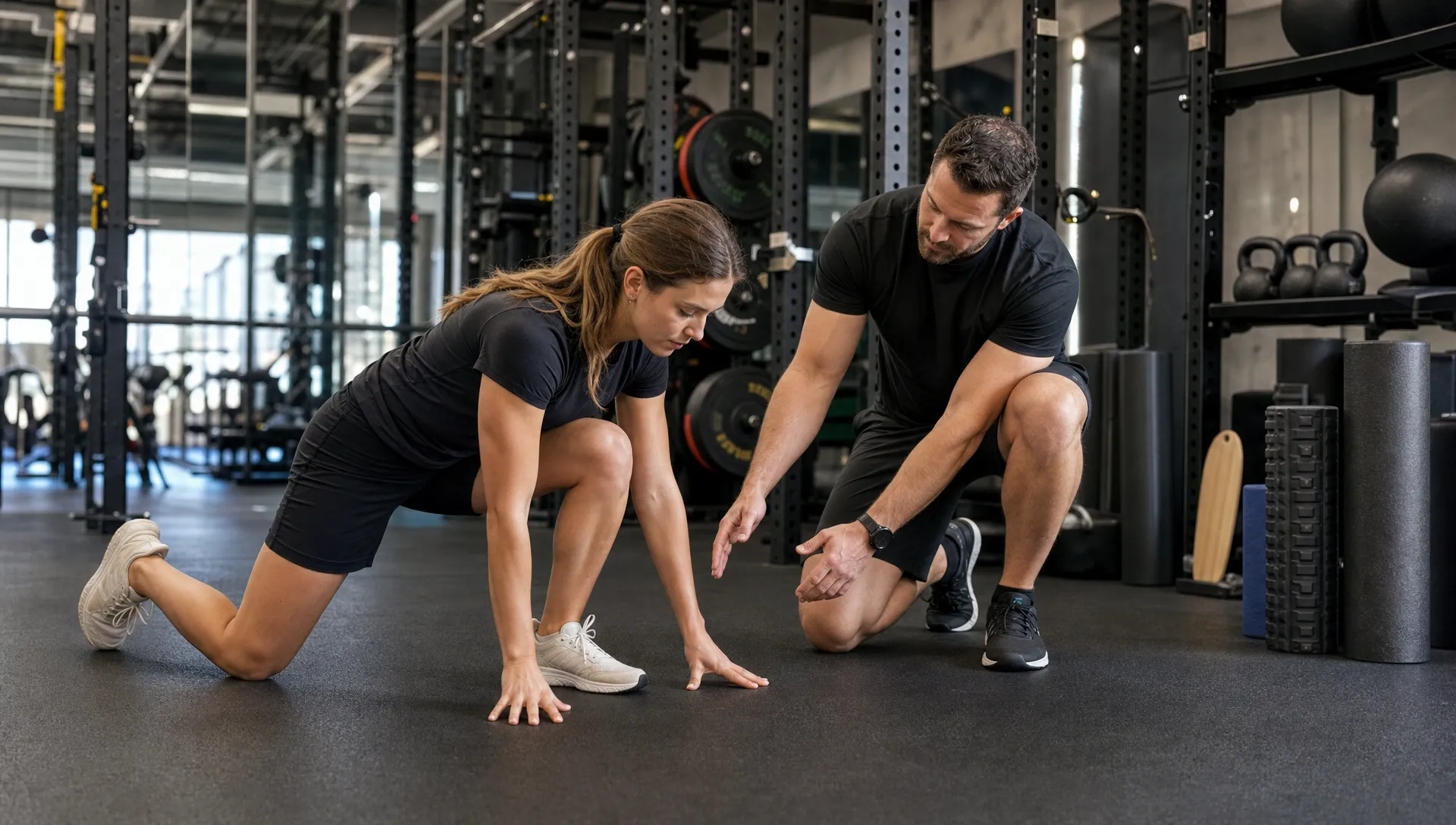
5. The Facility Is Built Around Outcomes, Not Trends
Equipment matters, but the question is whether the space supports the work you actually need. A gym built for progress should have enough room for strength training, conditioning, mobility, assessment and coaching without making clients fight for space.
A well-designed training gym feels intentional. Equipment is maintained, the layout supports coaching visibility and the environment makes it easy to move between warmups, main lifts, accessories and recovery work.
A training space should match the work being done, with suitable equipment, room to move and consistent maintenance.
The same thinking applies when you evaluate a gym. Flashy equipment is less valuable than a facility that helps coaches coach well and helps clients train consistently. Look for a space that reduces friction rather than adding distractions.
6. Recovery and Nutrition Are Part of the System
Training is the stimulus. Adaptation happens when your body has enough recovery and nutrition to respond. If a gym only tells you to work harder, it may miss the factors that determine whether your results last.
A complete training gym should help you balance intensity with sleep, stress, soreness, travel and nutrition. This does not mean every workout has to be easy. It means the hard work should be placed where it makes sense.
Research on muscle-strengthening activity has linked regular strength training with lower risk of all-cause mortality, including findings summarized in the British Journal of Sports Medicine. But the people who benefit most are usually the ones who can keep training, not the ones who burn out after six weeks.
Recovery services can be valuable when they support the plan rather than distract from it. If that is a priority, this breakdown of how to choose a recovery gym that supports better training can help you evaluate the difference.
7. The Culture Makes Consistency Easier
The final sign is culture. A gym can have strong coaches and advanced testing but still be a poor fit if the environment does not match your personality, schedule or goals.
A long-term training gym should feel professional, welcoming and focused. You should not feel rushed through sessions or ignored between them. You should understand why you are doing the work and what comes next.
This is especially relevant for high-performing professionals, physicians and executives who already make dozens of decisions all day. The gym experience should reduce decision fatigue. Your plan, appointments, coaching cues and progress markers should be clear enough that showing up becomes the main job.
For concierge medicine practices, longevity clinics and employee benefits leaders, culture also affects referral confidence. A testing or training environment should feel credible, safe and aligned with the client experience you want people to have.
How to Evaluate a Training Gym Before You Commit
Before joining, ask questions that reveal how the gym thinks. The answers will tell you more than a tour.
- How do you assess new clients before training starts?
- How do you adjust programs when someone travels, gets sore or hits a plateau?
- What metrics do you track besides body weight?
- Who interprets DEXA, VO2 max or other testing results?
- How do coaches coordinate training, nutrition and recovery?
- What does progress usually look like after 30, 90 and 180 days?
The best training gym for you is not necessarily the most intense or the most luxurious. It is the one that can translate your goals into a repeatable plan, then keep refining that plan as your body adapts.
Cardiorespiratory fitness is one example of why this matters. A major JAMA meta-analysis found that higher cardiorespiratory fitness was associated with lower risk of all-cause mortality and cardiovascular events, as summarized on PubMed. If improving fitness is one of your goals, the gym should be able to measure, train and retest it intelligently.
Frequently Asked Questions
How do I know if a training gym is right for long-term progress? Look for assessment, structured programming, qualified coaching, recovery support and clear tracking. A gym that can explain how your plan will change over time is more likely to support lasting results.
Should a gym offer testing like DEXA or VO2 max? Not every client needs every test, but testing can be useful when it informs decisions. DEXA can help track body composition, while VO2 max testing can guide conditioning goals.
How often should my training plan change? It depends on your goal, experience and recovery. Most people need enough consistency to adapt, with small adjustments every few weeks and larger changes when progress slows or goals shift.
Is personal training better than working out alone? For many people, yes. Coaching can improve technique, accountability, exercise selection and progression, especially when the goal is to build sustainable strength, fitness or body composition changes.
Build Progress With a Smarter System
If you want training that supports more than the next workout, Custom Fit combines personal training, nutrition coaching, recovery services and advanced testing in San Francisco. Clients can work with professionals who understand how exercise, nutrition and body composition fit together.
Explore Custom Fit's San Francisco studio to see how a data-driven approach can help you train with more clarity, consistency and confidence.