VO₂ Max and Life Expectancy: What the Research Actually Says


VO₂ Max and Life Expectancy: What the Research Actually Says
In 2018, a study published in JAMA Network Open followed over 122,000 patients who underwent cardiopulmonary exercise testing over a 23-year period. The researchers stratified participants by cardiorespiratory fitness — measured as VO₂ max — and tracked mortality outcomes across the group.
The findings were unambiguous. Low cardiorespiratory fitness was associated with a higher risk of death than smoking, hypertension, diabetes, or coronary artery disease. The mortality benefit of moving from low to below-average fitness was comparable to quitting smoking. There was no ceiling effect: at every age and in every health category studied, higher VO₂ max was associated with better survival outcomes.
VO₂ max is not a performance metric for athletes. It is one of the most reliable indicators of how long and how well you are likely to live — and, critically, it is one of the few longevity markers that responds meaningfully to targeted training.
What VO₂ max actually measures
VO₂ max — maximal oxygen uptake — is the maximum volume of oxygen your body can extract from the air, transport through your cardiovascular system, and use in working muscles during sustained, intense exercise. It is expressed in milliliters of oxygen per kilogram of bodyweight per minute (mL/kg/min).
The number reflects the combined efficiency of your lungs, heart, blood, and muscles working together under aerobic demand. A high VO₂ max means your body can sustain a large oxygen delivery and utilization rate — which translates to greater cardiovascular reserve, more efficient energy production, and a lower physiological cost for any given level of physical activity.
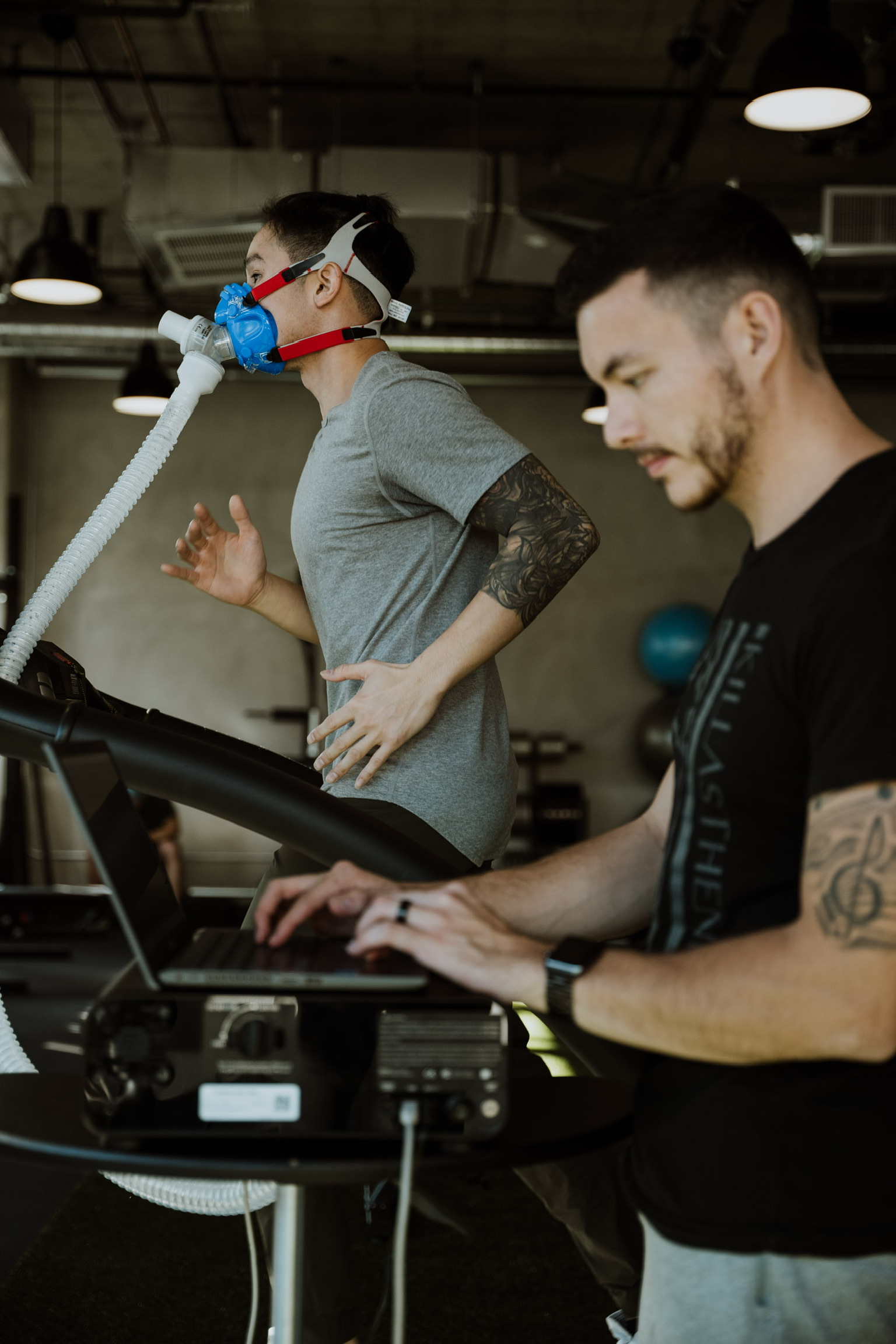
What it is not: an estimate derived from heart rate data, pace calculations, or wearable sensors. Devices that report a "VO₂ max estimate" are using algorithms built from population averages. They can suggest a ballpark. They cannot tell you your actual number, and the gap between estimated and measured VO₂ max in any individual can be substantial. A clinical test with a metabolic analyzer and a respiratory mask is the only way to measure it directly.
What the research connects VO₂ max to
The JAMA Network Open study mentioned above is one of the more cited examples, but it is not an outlier. The relationship between cardiorespiratory fitness and longevity has been replicated across dozens of large population studies over the past three decades. A few findings worth understanding:
All-cause and cardiovascular mortality. The association between VO₂ max and reduced risk of death from any cause — and from cardiovascular disease specifically — is among the strongest and most consistent in the exercise physiology literature. A 2022 meta-analysis in the British Journal of Sports Medicine, drawing on data from over 20 million person-years of follow-up, confirmed that each one-MET improvement in cardiorespiratory fitness was associated with a roughly 11–17% reduction in all-cause mortality risk.
Cancer mortality. A growing body of research links higher VO₂ max with reduced risk of cancer mortality, including for cancers of the colon, breast, and lung. The mechanisms are still being studied, but reduced systemic inflammation, improved immune function, and better metabolic health appear to be contributors.
Cognitive decline. Cardiorespiratory fitness is one of the more robust predictors of late-life cognitive health. Higher VO₂ max is associated with greater brain volume, better executive function, and reduced risk of dementia. The leading explanation is that aerobic fitness maintains cerebral blood flow and supports the neuroplasticity mechanisms that protect against age-related cognitive decline.
Metabolic health. VO₂ max is closely related to insulin sensitivity and metabolic flexibility — the body's ability to shift efficiently between fat and carbohydrate as fuel. Higher cardiorespiratory fitness is associated with lower incidence of type 2 diabetes and better blood sugar regulation, even independent of body weight.
The consistency of these findings across different populations, study designs, and outcome measures is what gives VO₂ max its standing as a longevity marker. Most biomarkers predict one or two health outcomes. VO₂ max shows up across almost all of them.
How VO₂ max changes with age
VO₂ max peaks in most people somewhere between their late teens and late 20s, then declines at a rate of roughly 10% per decade in sedentary individuals. By age 60, a person who was never regularly active may have a VO₂ max 40–50% below their peak.
That rate of decline is not fixed. Research consistently shows that regular aerobic training slows the decline significantly — in some studies, highly trained older athletes show VO₂ max values that overlap with or exceed those of sedentary adults 20 or 30 years younger. The decline is real and unavoidable, but its slope is heavily influenced by training behavior.
The practical implication is that VO₂ max improvement is not a young person's project. Studies in adults in their 60s, 70s, and even 80s show meaningful increases in cardiorespiratory fitness in response to structured training — with corresponding improvements in functional capacity, metabolic markers, and quality of life. The return on improving VO₂ max is arguably highest in the populations who have let it slip the furthest.
What your VO₂ max number actually means
VO₂ max values are typically interpreted using age- and sex-stratified reference ranges, which place your result in a fitness category — poor, fair, good, excellent, superior — relative to a reference population. A few things to understand about those categories:
The reference population matters. Standard reference tables are built from large, general populations that include sedentary individuals. Being "excellent" by general population standards may not reflect elite fitness. Being "fair" in a general table can still represent a meaningful cardiovascular risk if you are young and the underlying decline has already begun.
The number is less important than the trend. A VO₂ max of 42 mL/kg/min is a starting point. Whether that number is moving up, holding steady, or declining over a six-month training period is what determines whether your current approach is working. A single measurement provides context. Serial measurements provide direction.
The training zone data may be more immediately useful. A clinical VO₂ max test identifies your ventilatory threshold — the intensity at which your body shifts from primarily aerobic to primarily anaerobic metabolism. This produces precise, individualized heart rate training zones that cannot be reliably estimated from formulas like 220 minus age. Training with accurate zones means your easy work is genuinely easy and your hard work is appropriately hard — which is the foundation of effective aerobic development.
What actually moves the number
VO₂ max is trainable, but the training stimulus that drives improvement is specific. Two approaches have the strongest evidence:
High-intensity interval training (HIIT). Short bouts of work at or near maximal effort — typically 3 to 8 minutes — interspersed with recovery periods. This stimulus directly challenges and adapts the central cardiovascular components of VO₂ max: cardiac output, stroke volume, and oxygen delivery capacity. Norwegian 4x4 interval training (four four-minute intervals at approximately 85–95% of maximal heart rate) has one of the stronger evidence bases for VO₂ max improvement across age groups.
High-volume aerobic training. For individuals with a significant aerobic base, total training volume — time spent at moderate intensity, below the ventilatory threshold — drives adaptations in the peripheral delivery and utilization of oxygen. Elite endurance athletes spend the majority of their training time here, not at high intensity.
For most non-athletes, a combination of the two — the majority of training at genuinely easy effort, with one or two weekly sessions of structured high-intensity work — produces the best VO₂ max outcomes. The key constraint is having accurate training zones to execute this correctly, which requires a measured ventilatory threshold rather than an estimated one.
Without a baseline measurement, training intensity is guesswork. With a measured VO₂ max and confirmed ventilatory threshold, training can be precisely calibrated and its effects can be directly verified at the next test.
Why VO₂ max is one data point, not the whole picture
VO₂ max captures cardiovascular fitness and aerobic capacity. It does not capture body composition, muscle mass distribution, bone density, metabolic blood markers, or genetic predispositions — all of which independently influence long-term health.
Someone can have a high VO₂ max and carry high visceral fat, or show favorable body composition while having cardiovascular risk markers in their bloodwork that the fitness metric doesn't reveal. These variables interact, but they don't substitute for each other.
This is why the Longevity Blueprint structures VO₂ max testing alongside a DEXA scan, advanced bloodwork, and your choice of Nutrigenomix genetic testing or Vault Kinetics strength testing. Each test fills a gap the others leave. VO₂ max tells you the strength of your cardiovascular engine. DEXA tells you the composition of the body that engine is running. Bloodwork tells you what's happening at the metabolic and inflammatory level. Your selected fourth test adds genetic context or a current strength baseline.
Together, they replace estimation with measurement across the variables that have the clearest connection to how well and how long you live.
Getting tested in San Francisco
VO₂ max testing at Custom Fit is performed using a clinical-grade metabolic analyzer and respiratory mask, with the option for a maximal or submaximal protocol depending on your fitness level and goals. The test takes approximately 60 minutes and includes a results review with a certified exercise physiologist immediately following the session.
Testing is available at Custom Fit's Hayes Valley and Downtown SF locations, open to members and non-members. Unlimited VO₂ max retesting is included with all personal training memberships.
Book a VO₂ Max test or learn how it fits into the Longevity Blueprint.
VO₂ max testing at Custom Fit is conducted by certified exercise physiologists. Results are for health optimization and performance purposes and are not intended as medical diagnosis or treatment.